NMN vs NR: the NAD+ precursor comparison
 Written byKarina Ahrenholt
 Reviewed bySamo Borko | Biochemist and Expert Formulator at Purovitalis
NMN (nicotinamide mononucleotide) and NR (nicotinamide riboside) are both NAD+ precursors: the body turns NR into NMN, and NMN into NAD+. Neither has been shown to be better. In the first study that compared them directly, both raised NAD+ in the blood to a similar extent over 14 days. NR has been tested in more and longer human trials; NMN trials are newer and mostly small.
Below you find how they differ, what human studies show for each, how NMN differs from NAD+ itself, what is known about safety and the amounts used in studies.
One-minute summary
- Same pathway. NR → NMN → NAD+. NMN is one step closer to NAD+; NR is a form of vitamin B3.
- NAD+ in the blood. Both raised it in randomised trials. In a 2026 head-to-head study the rise was similar for NR and NMN.
- Amount of research. NR has more and longer human trials, including trials of 6 to 12 months; NMN trials mostly lasted 6 to 12 weeks.
- Health outcomes. Results on muscle function, walking and metabolism are mixed and come from small trials. A large one-year NR trial in Parkinson’s disease found no benefit; symptom scores were slightly worse than with placebo.
- Safety. Both were generally well tolerated in trials of up to a year. Data over several years are missing.
What actually differs between NMN vs NR?
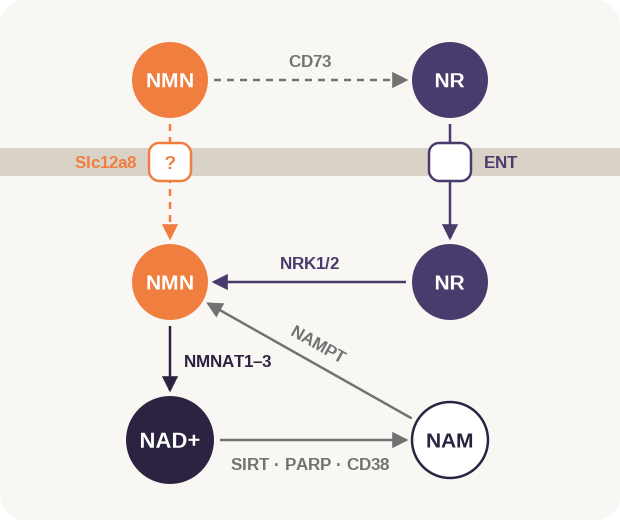
Position in the pathway. In the salvage pathway, enzymes called NR kinases turn NR into NMN, and enzymes called NMNATs turn NMN into NAD+. NMN is one step closer to NAD+.
Molecule. NMN is NR with a phosphate group attached. NR is a form of vitamin B3 found in trace amounts in milk.
Getting into cells. NR can enter cells through transporters for nucleosides, although after swallowing, part of it is broken down in the gut first. How NMN gets into cells is still debated: in mice, researchers described a transporter for NMN in the small intestine in 2019, other researchers disputed that finding, and some studies suggest that NMN is first converted to NR outside the cell.
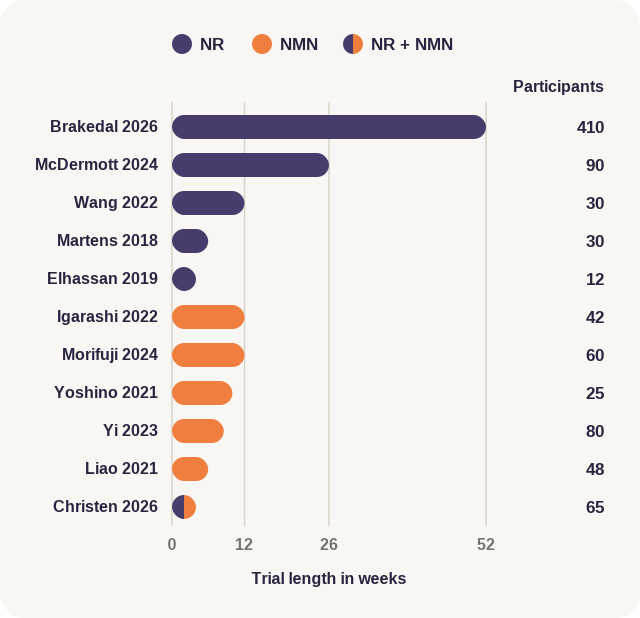
Research. NR has been studied in more and longer human trials, in healthy adults and in patient groups. NMN trials are newer, mostly small and mostly in healthy or older adults in Asia, especially Japan.
NMN or NAD+: what is the difference?
NAD+ is the coenzyme your cells use; NMN is a precursor that the body turns into NAD+ in one step. Supplements that contain NAD+ itself have been studied far less in people than NMN or NR, so it is not known how they compare. NAD+ is a larger molecule, and how much of it is absorbed intact when taken by mouth is unclear.
What human studies show
Head-to-head: NMN and NR in the same study
In a 2026 study, 65 healthy adults took 1,000 mg NR, 1,000 mg NMN, 500 mg nicotinamide or a placebo daily for 14 days. NR and NMN raised NAD+ in the blood to a similar extent; nicotinamide did not. The study was small and open-label, was run by Nestlé researchers, and did not measure NAD+ in tissues such as muscle. Lab experiments with stool samples in the same paper suggest that gut microbes may convert part of NR and NMN to nicotinic acid first.
NMN: 5 notable studies
- Women with prediabetes (2021). In a 10-week trial in 25 postmenopausal women, 250 mg a day raised NAD+ in blood cells but not in muscle, and muscle insulin sensitivity measured in the lab increased; body composition, blood pressure and blood lipids did not change. The trial was small (13 women took NMN) and needs confirmation.
- Healthy older men (2022). 250 mg a day for 12 weeks raised NAD+ in the blood. Gait speed and one grip test changed slightly, a result the authors say needs larger studies; body composition did not change.
- Healthy middle-aged adults (2023). In a 60-day trial in 80 adults, 300, 600 or 900 mg a day raised NAD+ in the blood; the rise was larger at 600 and 900 mg than at 300 mg, with little difference between 600 and 900 mg. The trial was funded by NMN manufacturers.
- Older adults, walking and sleep (2024). In a 12-week trial in 60 older adults, 250 mg a day did not change the main outcome, a stepping test. The 4-metre walking time and sleep questionnaire scores were better than with placebo. The study was run by researchers of a food company.
- Amateur runners (2021). In a 6-week trial in 48 runners who kept training, measures of aerobic capacity at 600 and 1,200 mg a day rose more than with placebo; maximum oxygen uptake did not change.
A 2025 meta-analysis of trials in adults over 60 found no clear effect of NMN on muscle mass, grip strength or walking speed; the few NR trials gave mixed results and could not be pooled.
NR: 5 notable studies
- Healthy middle-aged and older adults (2018). In a six-week crossover trial in 30 people (24 completed), 1,000 mg a day was well tolerated and raised NAD+ in blood cells. Changes in blood pressure and arterial stiffness were exploratory.
- Older men, muscle (2019). In a 21-day crossover trial in 12 men, 1,000 mg a day raised NAD+-related metabolites in muscle and lowered some inflammatory markers in the blood. It did not change how muscle mitochondria produce energy.
- Heart failure (2022). In a 12-week randomised safety trial in 30 patients (20 took NR), up to 1,000 mg twice a day appeared safe and roughly doubled NAD+ in the blood. The trial was designed to test safety, not effect.
- Peripheral artery disease (2024). In a six-month trial in 90 people (three groups of about 30), those taking NR walked 17.6 metres further in 6 minutes than the placebo group, which met the trial’s lenient pre-set threshold for significance. NR combined with resveratrol did not differ from placebo. The authors call for a larger trial.
- Parkinson’s disease (2026). In a one-year trial in 410 people with early Parkinson’s disease, 500 mg twice a day did not help; symptom scores worsened slightly more with NR than with placebo.
Safety notes
In short trials, NR and NMN were generally well tolerated. NR has been studied at 1,000 mg a day for six weeks in healthy middle-aged and older adults, and at 3,000 mg a day for four weeks in a safety trial of 20 people with Parkinson’s disease, half of whom took NR. In the one-year Parkinson’s trial (1,000 mg a day, 410 people, half of whom took NR), serious adverse events were no more common with NR than with placebo. A 2026 meta-analysis of randomised NMN trials found no increase in side effects compared with placebo; the longest trial lasted 24 weeks. In the individual trials, reported complaints were mostly mild. Flushing, the warm, red skin typical of niacin, has only occasionally been reported with NR or NMN, and at similar rates with placebo.
What is missing are data over several years. Do you use medication, are you pregnant or breastfeeding, or do you have a medical condition? Talk to your doctor or pharmacist first.
Find what fits you
Answer a few short questions and discover which supplements match your goals and daily routine.
Find your supplementHow much NMN and NR is used in studies?
| NMN | NR | |
|---|---|---|
| Usual amounts in trials | 250–1,200 mg a day | 250–1,000 mg a day |
| Highest amounts tested | Up to 2,000 mg a day for four weeks | Up to 3,000 mg a day for four weeks |
| Trial length | 4–24 weeks (most 6–12 weeks) | 3 weeks to 12 months (most 6–12 weeks) |
There is no official daily reference intake for NR or NMN.
What David Sinclair says about NMN vs NR
David Sinclair is a Harvard researcher whose lab studied NAD+ in ageing mice. In one of those studies, a week of NMN reversed a breakdown in communication between the cell nucleus and the mitochondria in old mice; in another, NMN increased small blood vessels and endurance in old mice. In his 2019 book Lifespan, he writes that he takes NMN himself. He is also linked to a company developing an NMN-based drug.
On X he has written about the comparison more than once. In a 2024 thread on a review of NMN and NR studies, he summed up the difference: NMN is NR with an added phosphate group; NMN enters cells through its own transporter or is first converted to NR, while NR is taken up and converted to NMN inside the cell. He added that doses up to 2,000 mg a day had been well tolerated so far.
In a 2019 post he asked the same question, “Is one better?”, and pointed to mouse studies of both and to early human trials. In a follow-up that day he added a rule for reading research: “cell culture results are trumped by mouse results. Mouse results are trumped by human results.”
That is how this article is built: human trials first, mouse studies as background. A researcher’s personal choice is not trial evidence, and in humans the only head-to-head study so far found a similar rise in blood NAD+ with NMN and NR.
What our customers ask us about NMN and NR
Between November 2025 and November 2026, our customer service received about 12,000 emails and chats. In eight of them, a customer asked us to help choose between NMN and NR, or between our Liposomal NMN Capsules and our NAD+ Booster, which contains NR. Five more customers asked to swap one for the other. The questions came down to three points:
- Which one is better? Research does not show a winner; the first head-to-head study found a similar rise in blood NAD+.
- Should I combine or alternate them? No study has tested taking NMN and NR together, or switching between them. Both end up in the same pathway.
- How long can I take them? The trials lasted from a few weeks to a year; data over several years are missing. Read more about NMN side effects and what our customers report.
Several customers called our NAD+ Booster simply “NAD+”. The name can be confusing: one capsule contains 250 mg of nicotinamide riboside (NR), together with nicotinamide, anthocyanins and L-ergothioneine, and no NAD+ itself. Our Liposomal NMN Capsules contain 125 mg of NMN per capsule.
Simple buyer’s guide
These points on the label help you compare NMN and NR supplements:
- Which precursor it contains, and how many milligrams per daily dose, compared with the amounts used in studies
- For NMN: the form used in studies, β-NMN
- Whether the product combines several precursors or other ingredients, and how much of each
- A certificate of analysis or an independent lab test for purity
Our products are made in Europe under GMP conditions and tested by an independent laboratory for purity and heavy metals, with a certificate of analysis available for each batch.
NMN vs NR in brief
NMN and NR feed the same pathway and both raised NAD+ in the blood in human trials, to a similar extent in the first head-to-head study. NR has the longer research record; NMN trials are newer and smaller. Whether a higher NAD+ level in the blood leads to health benefits is still open.
Read more:
Frequently asked questions
No. Both raised NAD+ in the blood in human trials, and in the first head-to-head study they did so to a similar extent over 14 days. No trial has shown that one leads to better health outcomes than the other.
They are not the same kind of ingredient. NAD+ is the coenzyme itself; NMN is one step before it. NAD+ taken by mouth has been studied far less in people than NMN or NR, so a direct comparison is not possible yet.
Both feed the same pathway, and most trials tested one precursor at a time. There are no human data showing that combining them gives more than one of them alone.
He has written that NMN and NR are both NAD+ precursors that enter cells in different ways, and that results in people outweigh results in mice. In his book Lifespan he writes that he takes NMN himself; that is a personal choice, not trial evidence, and he is linked to a company developing an NMN-based drug.
Most NMN and NR trials ran from 6 to 12 weeks; a few NR trials lasted 6 to 12 months. Blood NAD+ was higher after 14 days in the head-to-head study.
References
- Brakedal B, et al. (2026). Nicotinamide riboside for patients with early-stage Parkinson disease: the NOPARK randomized clinical trial. JAMA, e2618828. https://pubmed.ncbi.nlm.nih.gov/42848371/
- Berven H, et al. (2023). NR-SAFE: a randomized, double-blind safety trial of high dose nicotinamide riboside in Parkinson’s disease. Nature Communications, 14, 7793. https://pubmed.ncbi.nlm.nih.gov/38016950/
- Christen S, et al. (2026). The differential impact of three different NAD+ boosters on circulatory NAD and microbial metabolism in humans. Nature Metabolism, 8(1), 62-73. https://pubmed.ncbi.nlm.nih.gov/41540253/
- Das A, et al. (2018). Impairment of an endothelial NAD+-H2S signaling network is a reversible cause of vascular aging. Cell, 173(1), 74-89.e20. https://pubmed.ncbi.nlm.nih.gov/29570999/
- Elhassan YS, et al. (2019). Nicotinamide riboside augments the aged human skeletal muscle NAD+ metabolome and induces transcriptomic and anti-inflammatory signatures. Cell Reports, 28(7), 1717-1728.e6. https://pubmed.ncbi.nlm.nih.gov/31412242/
- Gomes AP, et al. (2013). Declining NAD+ induces a pseudohypoxic state disrupting nuclear-mitochondrial communication during aging. Cell, 155(7), 1624-1638. https://pubmed.ncbi.nlm.nih.gov/24360282/
- Grozio A, et al. (2019). Slc12a8 is a nicotinamide mononucleotide transporter. Nature Metabolism, 1(1), 47-57. https://pubmed.ncbi.nlm.nih.gov/31131364/
- Schmidt MS, Brenner C. (2019). Absence of evidence that Slc12a8 encodes a nicotinamide mononucleotide transporter. Nature Metabolism, 1(7), 660-661. https://pubmed.ncbi.nlm.nih.gov/32694648/
- Igarashi M, et al. (2022). Chronic nicotinamide mononucleotide supplementation elevates blood nicotinamide adenine dinucleotide levels and alters muscle function in healthy older men. npj Aging, 8(1), 5. https://pubmed.ncbi.nlm.nih.gov/35927255/
- Liao B, et al. (2021). Nicotinamide mononucleotide supplementation enhances aerobic capacity in amateur runners: a randomized, double-blind study. Journal of the International Society of Sports Nutrition, 18(1), 54. https://pubmed.ncbi.nlm.nih.gov/34238308/
- Martens CR, et al. (2018). Chronic nicotinamide riboside supplementation is well-tolerated and elevates NAD+ in healthy middle-aged and older adults. Nature Communications, 9(1), 1286. https://pubmed.ncbi.nlm.nih.gov/29599478/
- McDermott MM, et al. (2024). Nicotinamide riboside for peripheral artery disease: the NICE randomized clinical trial. Nature Communications, 15(1), 5046. https://pubmed.ncbi.nlm.nih.gov/38871717/
- Morifuji M, et al. (2024). Ingestion of β-nicotinamide mononucleotide increased blood NAD levels, maintained walking speed, and improved sleep quality in older adults in a double-blind randomized, placebo-controlled study. GeroScience, 46(5), 4671-4688. https://pubmed.ncbi.nlm.nih.gov/38789831/
- Prokopidis K, et al. (2025). The effect of nicotinamide mononucleotide and riboside on skeletal muscle mass and function: a systematic review and meta-analysis. Journal of Cachexia, Sarcopenia and Muscle, 16(3), e13799. https://pubmed.ncbi.nlm.nih.gov/40275690/
- Wang DD, et al. (2022). Safety and tolerability of nicotinamide riboside in heart failure with reduced ejection fraction. JACC: Basic to Translational Science, 7(12), 1183-1196. https://pubmed.ncbi.nlm.nih.gov/36644285/
- Yang W, et al. (2026). Safety and metabolism-related outcomes of oral nicotinamide mononucleotide supplementation in adults: a systematic review and meta-analysis. Nutrients, 18(14), 2251. https://pubmed.ncbi.nlm.nih.gov/42514320/
- Yi L, et al. (2023). The efficacy and safety of β-nicotinamide mononucleotide (NMN) supplementation in healthy middle-aged adults: a randomized, multicenter, double-blind, placebo-controlled, parallel-group, dose-dependent clinical trial. GeroScience, 45(1), 29-43. https://pubmed.ncbi.nlm.nih.gov/36482258/
- Yoshino M, et al. (2021). Nicotinamide mononucleotide increases muscle insulin sensitivity in prediabetic women. Science, 372(6547), 1224-1229. https://pubmed.ncbi.nlm.nih.gov/33888596/
Add Purovitalis as a preferred source on Google Google then shows more of our articles in your search results.


 English
 Dutch
 German
 French
 Spanish
 Romanian
 Danish
 Italian