
Is liquid collagen better than powder and pills?
 Written byKarina Ahrenholt
 Reviewed bySamo Borko | Biochemist and Expert Formulator at Purovitalis
For collagen supplements, the form matters less than the dose. Drinks, powders, capsules and gummies usually contain the same kind of ingredient, hydrolysed collagen peptides, and we found no trial that compared their absorption head to head. What differs is how many grams of collagen you get per serving: skin studies mostly used 2.5 to 10 grams a day, which is one scoop of powder or one drink, but often several capsules.
Below you find a comparison table, what each form is, the types of collagen, how much people take in studies, and what to look for on the label.
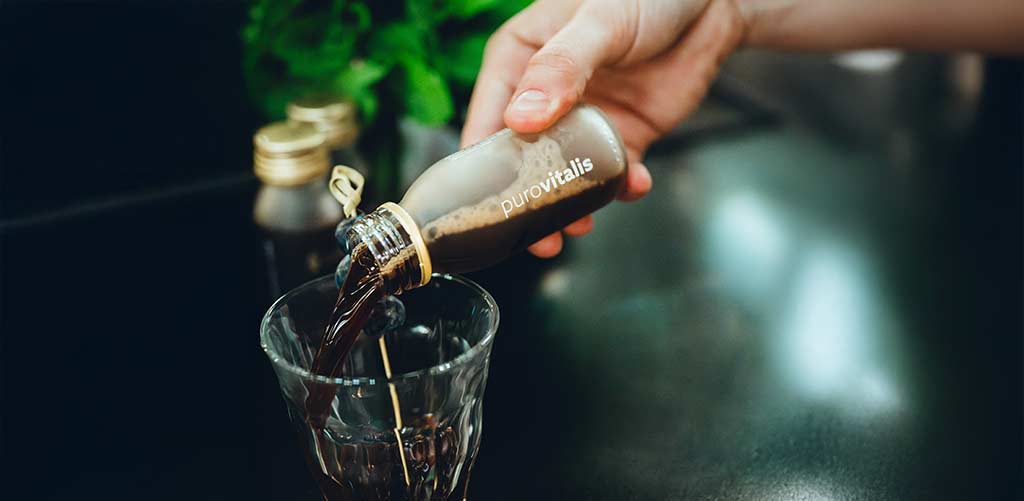
Liquid collagen vs. powder vs. pills
The table compares the forms on what you can check yourself: the amount of collagen per serving, how easy it is to use and what else is usually in it. The amounts are typical ranges; the label of each product shows its own.
| Form | Collagen per serving (typical) | Ease of use | Watch for |
|---|---|---|---|
| Liquid collagen (drink or shot) | 2.5–10 g per bottle or shot | Ready to drink, pre-dosed | Sweeteners or sugar, shorter shelf life once opened |
| Powder | 5–10 g per scoop; a serving is often 10–20 g | Mix into water, coffee, yoghurt or a smoothie | Taste and texture; flavoured versions can contain sugar |
| Capsules or tablets | About 0.3–1 g per capsule or tablet | Swallow with water, no taste | Several capsules needed to reach the amounts used in studies |
| Gummies (chews) | Often 1–3 g per serving | Easy, like a sweet | Sugar or sweeteners per serving; often less collagen |
What is liquid collagen?
Liquid collagen is hydrolysed collagen dissolved in a drink, sold as a ready-to-drink bottle or a small shot. Because it is already dissolved and pre-dosed, it is the simplest form to take, but it usually costs more per gram and often contains added flavourings or sweeteners.
Pros:
- Ready to drink and pre-dosed
- Reaches the amounts used in studies in one serving
- Several flavours available
Cons:
- Usually more expensive per gram of collagen
- Shorter shelf life once opened
- May contain added sugar or sweeteners
What is powder collagen?
Collagen powder is the most common form in shops, and many collagen studies used powders dissolved in water or a drink. Hydrolysed collagen powder dissolves in cold and hot drinks, so you can mix it into water, coffee, tea, yoghurt or a smoothie.
Does it matter what you mix it with? A 2025 randomised crossover study in healthy volunteers, run by researchers from a collagen manufacturer, compared collagen peptides taken in coffee with the same peptides in water. Two amino acids (hydroxyproline and proline) rose differently over time in coffee, while the collagen peptides measured in the blood reached similar levels in both drinks. It is a single study of one dose, so it does not show that one drink is better than another.
Pros:
- Easy to adjust the amount
- Usually the lowest price per gram
- Long shelf life
Cons:
- Needs mixing, so less handy on the go
- Some people notice a taste or texture
Collagen pills
Collagen capsules and tablets are easy to take and have no taste. The catch is the amount: a capsule usually holds about 0.3 to 1 gram of collagen, so reaching the 2.5 to 10 grams a day mostly used in skin studies takes several capsules, and up to ten or more for the higher amounts.
Pros:
- Easy to take, no taste or mixing
- Often few added ingredients
- Easy to carry
Cons:
- Little collagen per capsule
- Many capsules needed for the amounts used in studies
Collagen gummies
Collagen gummies vs powder: which gives more collagen? Usually powder. Gummies are easy to take, but a serving often holds only a few grams of collagen or less, together with sugar or sweeteners. Compare the grams of collagen per serving on the label, and how many gummies that serving is.
Hydrolyzed collagen
Hydrolysed collagen, also called collagen peptides or collagen hydrolysate, is collagen that has been broken down into small pieces (peptides) by hydrolysis. It is the form used in most drinks, powders, capsules and gummies. How far the collagen is broken down may matter for absorption: in a small randomised crossover study in 10 healthy men, a collagen hydrolysate that had been broken down further with enzymes raised amino acids typical of collagen in the blood faster than one that had not. It was a single 35-gram dose, several times a usual serving, and the study measured blood levels only.
Undenatured collagen is different. It is not broken down, it is usually type II collagen from chicken cartilage, and it is taken in very small amounts (about 40 milligrams) in joint studies. It is studied for another reason than hydrolysed collagen, so the two are not interchangeable.
| Collagen type | Where it is found in the body | In supplements |
|---|---|---|
| Type I | Skin, bones, tendons | Most common; from bovine or marine sources |
| Type II | Cartilage | Usually from chicken; studied for joints |
| Type III | Skin, blood vessels | Often together with type I in bovine collagen |
Find what fits you
Answer a few short questions and discover which supplements match your goals and daily routine.
Find your supplementHow much collagen should you take per day?
There is no official daily reference intake for collagen. Studies used different amounts depending on what they looked at: skin studies mostly used 2.5 to 10 grams a day for 8 to 12 weeks, and a study in older men who did strength training used 15 grams a day.
Whether collagen supplements change the skin is still debated. A 2026 meta-analysis of 35 randomised trials reported changes in skin hydration and elasticity, but not in wrinkles, while a 2025 meta-analysis of 23 trials found changes only in trials funded by industry and, for elasticity, in lower-quality trials; trials without industry funding and higher-quality trials showed none.
Are there side effects?
In studies, collagen supplements were generally well tolerated; the complaints reported were mild, such as a feeling of fullness or an upset stomach. Collagen comes from animals, so check the source on the label if you have an allergy: marine collagen comes from fish, and some products contain shellfish or egg.
Do you use medication, are you pregnant or breastfeeding, or do you have a medical condition? Then talk to your doctor or pharmacist before you start a supplement.
Which collagen supplement is the best?
There is no single best form. These points on the label make the comparison:
- Grams of collagen per serving, compared with the 2.5 to 10 grams mostly used in skin studies
- Hydrolysed collagen peptides, unless you are looking at undenatured type II
- The source (bovine, marine, chicken), for allergies and diet
- Added sugar or sweeteners, especially in gummies and drinks
- A certificate of analysis or independent lab test for the batch
Our Rewind Liquid Collagen contains 6 grams of bovine collagen peptides per 60 ml shot.
Liquid, powder or pills in brief
Drinks, powders, capsules and gummies usually contain the same kind of ingredient, hydrolysed collagen peptides, and we found no trial that compared their absorption head to head. The real difference is the grams per serving: a drink or a scoop of powder reaches the 2.5 to 10 grams mostly used in skin studies in one serving, capsules and gummies often do not. Whether collagen supplements change the skin is still debated, and there is no official daily reference intake.
Explore more here:
Frequently asked questions
When both contain hydrolysed collagen peptides, no trial has compared liquid and powder head to head, so there is no evidence that one is absorbed better. What differs is convenience and the dose per serving. Compare the grams of collagen peptides per serving.
No study has compared the two. Skin studies have mostly used 2.5 to 10 grams of hydrolysed collagen a day for 8 to 12 weeks. Capsules usually hold about 0.3 to 1 gram each, so reaching those amounts takes several capsules; a liquid or powder serving reaches them more easily. A 2026 meta-analysis found no robust change in wrinkles, only in hydration and elasticity, so whether collagen affects wrinkles is still open.
Hydrolysed collagen peptides dissolve in water-based drinks, so mixing them with electrolytes is a matter of taste. Types I and III, usually from bovine or marine sources, are the ones studied for skin; type II is studied for joints. Compare the grams of peptides per serving, and check the drink’s sugar content.
Collagen peptides are being researched in relation to skin, and there is early research into collagen and the gut lining, mostly in animals and small open-label studies. No single supplement has strong human evidence for both.
There is none: both names describe collagen that has been broken down into small pieces (peptides) by hydrolysis. You also see the terms collagen hydrolysate and hydrolysed collagen peptides on labels.
References
- Batool A, et al. (2026). Oral collagen peptides and skin rejuvenation: a systematic review and an updated meta-analysis of randomized controlled trials. Journal of Cosmetic Dermatology, 25(7), e71041. https://doi.org/10.1111/jocd.71041
- Myung SK, Park Y. (2025). Effects of collagen supplements on skin aging: a systematic review and meta-analysis of randomized controlled trials. American Journal of Medicine, 138(9), 1264-1277. https://pubmed.ncbi.nlm.nih.gov/40324552/
- Skov K, et al. (2019). Enzymatic hydrolysis of a collagen hydrolysate enhances postprandial absorption rate: a randomized controlled trial. Nutrients, 11(5), 1064. https://pubmed.ncbi.nlm.nih.gov/31086034/
- Virgilio N, et al. (2025). Unravelling the bioavailability of amino acids and bioactive peptides from collagen hydrolysate in coffee in healthy volunteers. Food Research International, 211, 116478. https://pubmed.ncbi.nlm.nih.gov/40356137/
- Zdzieblik D, et al. (2015). Collagen peptide supplementation in combination with resistance training improves body composition and increases muscle strength in elderly sarcopenic men: a randomised controlled trial. British Journal of Nutrition, 114(8), 1237-1245. https://pubmed.ncbi.nlm.nih.gov/26353786/
Add Purovitalis as a preferred source on Google Google then shows more of our articles in your search results.



 English
 Dutch
 German
 French
 Spanish
 Romanian
 Danish
 Italian