7 NAD+ precursors: what they are, how they work and what human research shows
 Written byKarina Ahrenholt
 Reviewed bySamo Borko | Biochemist and Expert Formulator at Purovitalis
An NAD+ precursor is a molecule the body can turn into NAD+, a coenzyme that cells use in energy metabolism and in enzymes involved in DNA repair. There are seven main ones: nicotinamide riboside (NR), nicotinamide mononucleotide (NMN), nicotinamide (NAM), nicotinic acid (niacin), the reduced forms NRH and NMNH, and the amino acid tryptophan. NR and NMN have the most human research; NRH and NMNH have only been studied in cells and animals.
Below you find how the body makes NAD+, a comparison table, what research shows for each precursor, what is known about safety, and the amounts used in studies.
The pathways in one minute
Your body makes NAD+ in three ways:
- Salvage pathway (the main route in most tissues): recycles nicotinamide (NAM) back into NAD+ with the enzyme NAMPT. NR is turned into NMN, and NMN into NAD+.
- Preiss–Handler pathway: makes NAD+ from nicotinic acid (niacin).
- De novo pathway: builds NAD+ from the amino acid tryptophan, via the kynurenine pathway; slow, tightly regulated and mainly active in the liver.
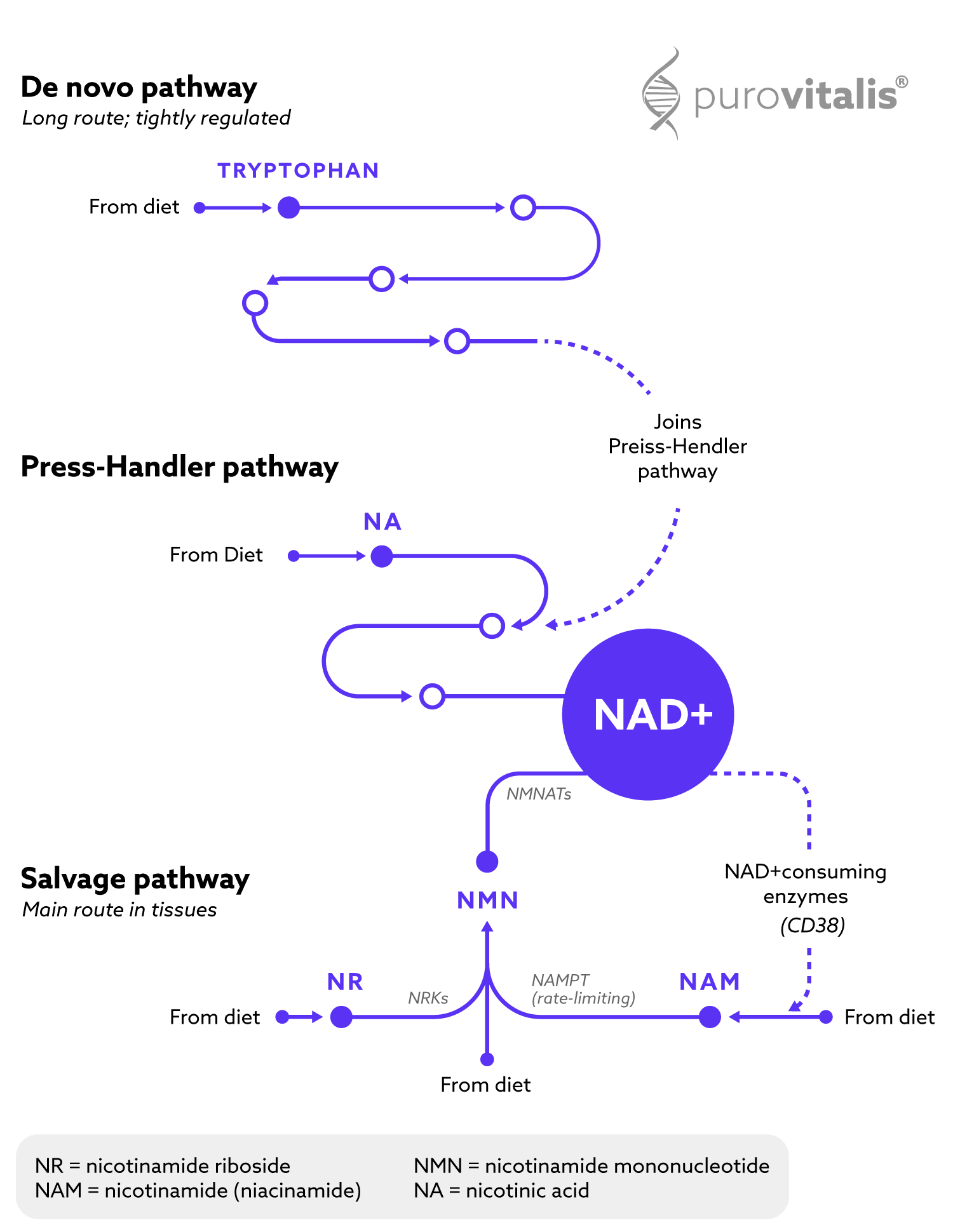
Where does NAD+ come from in the body? Most of it is recycled rather than made new: enzymes such as PARPs, sirtuins and CD38 use NAD+ up, and the salvage pathway turns what is left (nicotinamide) back into NAD+.
Is NAC a precursor to NAD+? No. NAC (N-acetylcysteine) is a form of the amino acid cysteine that the body uses to make glutathione, not NAD+; the names are just similar.
At-a-glance: NAD+ precursors comparison
The table compares the seven precursors on how they feed into NAD+ and how much human research there is. “Human data” describes the amount of research, not whether a precursor works.
| Precursor | How it feeds NAD+ | Human data | Notes |
|---|---|---|---|
| Nicotinamide riboside (NR) | Salvage: NR → NMN → NAD+ | Several randomised trials | Raised NAD+ in the blood; studied up to 3,000 mg a day for four weeks |
| Nicotinamide mononucleotide (NMN) | Salvage: NMN → NAD+ | Several randomised trials | Raised NAD+ in the blood; trials up to 24 weeks |
| Nicotinamide (NAM) | Salvage via NAMPT → NMN → NAD+ | Vitamin B3 form; long history | Did not raise blood NAD+ in a 2026 head-to-head study; high amounts slow sirtuins in the lab |
| Nicotinic acid (NA, niacin) | Preiss–Handler → NAD+ | Vitamin B3 form; long history | Flushing is common; high doses only under medical supervision |
| NRH | Reduced NR → NAD+ | Cell and animal only | Inflammatory signals in immune cells in the lab |
| NMNH | Reduced NMN → NAD+ and NADH | Cell and animal only | Stability and safety in people unknown |
| Tryptophan | De novo → NAD+ | Dietary amino acid | Slow and tightly regulated route |
Which precursor raises NAD+ most in people? Few studies have compared them directly. In a 2026 study, 65 healthy adults took 1,000 mg NR, 1,000 mg NMN, 500 mg nicotinamide or a placebo daily for 14 days. NR and NMN raised NAD+ in the blood to a similar extent; nicotinamide did not. The study was small and open-label, was run by Nestlé researchers, and did not measure NAD+ in tissues such as muscle. Lab experiments with stool samples in the same paper suggest that gut microbes may convert part of NR and NMN to nicotinic acid first.
Safety and future directions
Is it safe to take NAD+ precursors?
In short trials, NR and NMN were generally well tolerated. NR has been studied at 1,000 mg a day for six weeks in healthy middle-aged and older adults, and at 3,000 mg a day for four weeks in a safety trial of 20 people with Parkinson’s disease, half of whom took NR. A 2026 meta-analysis of randomised NMN trials found no increase in side effects compared with placebo; the longest trial lasted 24 weeks. In these trials, most reported complaints were mild.
What is missing are data over years: nobody knows yet what keeping NAD+ higher for a long time does. Niacin is a different case: it often causes flushing, and the high doses used for blood lipids are only taken under medical supervision.
Do you use medication, are you pregnant or breastfeeding, or do you have a medical condition? Then talk to your doctor or pharmacist before you start an NAD+ precursor.
Future directions
Raising NAD+ in the blood is not the same as showing a health benefit, and experts note that larger and longer trials are needed. A large NR trial, in 410 people with early Parkinson’s disease, found no benefit after a year on 500 mg twice a day; symptom scores worsened slightly more with NR than with placebo.
Researchers are also studying CD38 inhibitors, which slow the breakdown of NAD+, and new delivery forms. Human data on these are still limited.
The 7 NAD+ precursors explained
1. Nicotinamide riboside (NR)
NR is a form of vitamin B3 found in trace amounts in milk. In the salvage pathway, the body turns NR into NMN and then into NAD+.
Human data: in randomised trials, NAD+ in the blood rose after NR; measurements in muscle and brain are fewer and less consistent. In a six-week trial in 30 healthy middle-aged and older adults, 1,000 mg a day was well tolerated and raised NAD+ in blood cells.
Read more about nicotinamide riboside
2. Nicotinamide mononucleotide (NMN)
Is NMN a precursor to NAD+? Yes: NMN is one step away from NAD+ in the salvage pathway.
Human data: in several small randomised trials, NMN raised NAD+ in the blood. In a 10-week trial in 25 postmenopausal women with prediabetes, muscle insulin sensitivity measured in the lab increased. Results on muscle function are mixed: a 2025 meta-analysis of trials in adults over 60 found no clear effect of NMN on muscle mass, grip strength or walking speed; the few NR trials gave mixed results and could not be pooled.
3. Nicotinamide (NAM)
NAM, also called niacinamide, is the vitamin B3 form found in many multivitamins. The body recycles it into NAD+ with the enzyme NAMPT.
Human data: nicotinamide is a vitamin with a long history of use. In the 2026 head-to-head study, it did not raise NAD+ in the blood over two weeks, while NR and NMN did. In laboratory studies, high amounts slow sirtuins, enzymes that use NAD+.
Read more about niacin, nicotinamide and niacinamide
4. Nicotinic acid (NA, niacin)
Nicotinic acid is another vitamin B3 form. It feeds NAD+ production through the Preiss–Handler pathway.
Human data: in a small study of people with a mitochondrial muscle disease and matched healthy controls, niacin raised NAD+ in the blood. It often causes flushing, a warm, red skin. It has been used for decades at high doses to lower blood lipids, which is only done under medical supervision.
5. NRH (dihydronicotinamide riboside)
NRH is the reduced form of NR and enters the NAD+ pool through a different route.
Human data: none yet. In cells and mice, NRH raised NAD+ more than NR. In immune cells in the lab, it also triggered inflammatory signals, so its safety in people is still open.
6. NMNH (reduced NMN)
NMNH is the reduced form of NMN. It can feed into both the NAD+ and the NADH pool.
Human data: none yet. In cells, NMNH raised NAD+ more than NMN; in mice, NAD+ rose in blood and several tissues. Its stability and safety in people are unknown.
7. Tryptophan
Tryptophan is an essential amino acid found in protein-rich food. It feeds NAD+ production through the long de novo (kynurenine) pathway.
Human data: tryptophan contributes to NAD+ mainly in the liver. Because the route is slow and tightly regulated, extra tryptophan is not a practical way to raise NAD+ in most tissues.
Find what fits you
Answer a few short questions and discover which supplements match your goals and daily routine.
Find your supplementHallmarks of aging: where NAD+ fits
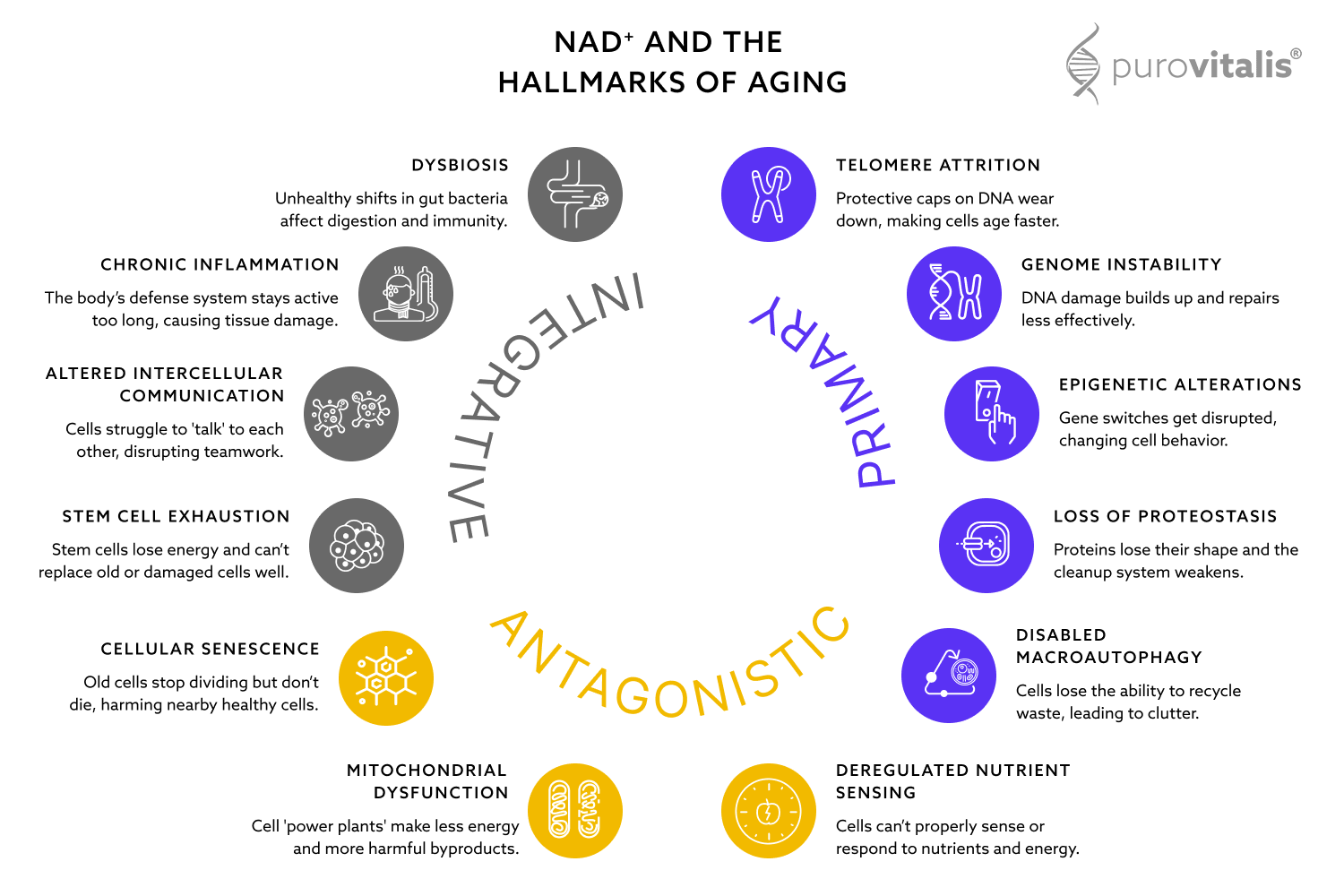
NAD+ is used by enzymes involved in several hallmarks of ageing: PARPs in DNA repair, sirtuins in epigenetic regulation and mitochondrial function, and enzymes linked to inflammation and senescence. That is why NAD+ is studied in relation to these hallmarks, mostly in cell and animal research.
CD38 is an enzyme that breaks down NAD+ and can also break down NMN. Its activity rises with age and inflammation, which is one explanation for lower NAD+ levels in older age. In animal studies, blocking CD38 kept NAD+ levels higher; CD38 inhibitors for people are still in research.
How much is used in studies?
There is no official daily reference intake for NR or NMN. Human studies mostly used 250 to 1,000 mg a day, for a few weeks to a few months; NR has been tested at up to 3,000 mg a day for four weeks, and NMN at up to 2,000 mg a day for four weeks. Nicotinamide and niacin are vitamin B3 forms, with their own upper limits for daily intake.
Buyer’s guide (quick and practical)
These points on the label help you compare NAD+ precursor supplements:
- Which precursor it contains, and how many milligrams per daily dose, compared with the amounts used in studies
- Whether the product combines several precursors, and how much of each
- A certificate of analysis or an independent lab test for purity
- Niacin: flushing is common; talk to your doctor if you use medication for blood lipids or blood sugar
- NRH and NMNH: no human trials have been published yet
Our products are made in Europe under GMP conditions and tested by an independent laboratory for purity and heavy metals, with a certificate of analysis available for each batch.
NAD+ precursors in brief
NAD+ precursors are molecules the body turns into NAD+. NR and NMN have the most human research and raised NAD+ in the blood in randomised trials; nicotinamide and niacin are vitamin B3 forms; NRH and NMNH have only been studied in cells and animals; tryptophan is a slow route. Short trials found NR and NMN generally well tolerated, but whether raising NAD+ changes health outcomes is still open.
Lifestyle is part of the picture too: in a 12-week training study, NAMPT, a key enzyme in NAD+ recycling, was higher in the muscle of younger and older adults afterwards; NAD+ itself was not measured.
Explore more here:
Frequently asked questions
NR and NMN. Both raised NAD+ in the blood in randomised human trials. Nicotinamide and niacin are vitamin B3 forms with a long history; NRH and NMNH have only been studied in cells and animals.
In a 2026 open-label study, NAD+ in the blood was higher after 14 days of NR or NMN. Whether that changes health outcomes is a separate question that larger trials still have to answer.
NMN raised NAD+ in the blood in several small randomised trials. In one 10-week trial in 25 postmenopausal women with prediabetes, muscle insulin sensitivity measured in the lab increased; the trial was small and needs confirmation.
Not in a practical sense for healthy people: the de novo route from tryptophan is slow and tightly regulated, and it mainly runs in the liver.
In laboratory studies, high amounts of nicotinamide can slow sirtuins, a family of enzymes that use NAD+. In a 2026 head-to-head study, nicotinamide did not raise NAD+ in the blood over two weeks. Talk to your doctor before taking high doses.
They have only been studied in cells and animals, and no human trials have been published yet. Treat them as emerging research.
In short trials, NR and NMN were generally well tolerated at the doses studied. Long-term data over years are still missing, and raising NAD+ in the blood is not the same as a proven health benefit.
References
- Berven H, et al. (2023). NR-SAFE: a randomized, double-blind safety trial of high dose nicotinamide riboside in Parkinson’s disease. Nature Communications, 14, 7793. https://pubmed.ncbi.nlm.nih.gov/38016950/
- Brakedal B, et al. (2026). Nicotinamide riboside for patients with early-stage Parkinson disease: the NOPARK randomized clinical trial. JAMA, e2618828. https://pubmed.ncbi.nlm.nih.gov/42848371/
- Chini CCS, et al. (2022). Dihydronicotinamide riboside is a potent NAD+ precursor promoting a pro-inflammatory phenotype in macrophages. Frontiers in Immunology, 13, 840246. https://pubmed.ncbi.nlm.nih.gov/35281060/
- Christen S, et al. (2026). The differential impact of three different NAD+ boosters on circulatory NAD and microbial metabolism in humans. Nature Metabolism, 8(1), 62-73. https://pubmed.ncbi.nlm.nih.gov/41540253/
- de Guia RM, et al. (2019). Aerobic and resistance exercise training reverses age-dependent decline in NAD+ salvage capacity in human skeletal muscle. Physiological Reports, 7(12), e14139. https://pubmed.ncbi.nlm.nih.gov/31207144/
- Martens CR, et al. (2018). Chronic nicotinamide riboside supplementation is well-tolerated and elevates NAD+ in healthy middle-aged and older adults. Nature Communications, 9(1), 1286. https://pubmed.ncbi.nlm.nih.gov/29599478/
- Prokopidis K, et al. (2025). The effect of nicotinamide mononucleotide and riboside on skeletal muscle mass and function: a systematic review and meta-analysis. Journal of Cachexia, Sarcopenia and Muscle, 16(3), e13799. https://pubmed.ncbi.nlm.nih.gov/40275690/
- Giroud-Gerbetant J, et al. (2019). A reduced form of nicotinamide riboside defines a new path for NAD+ biosynthesis and acts as an orally bioavailable NAD+ precursor. Molecular Metabolism, 30, 192-202. https://pubmed.ncbi.nlm.nih.gov/31767171/
- Pirinen E, et al. (2020). Niacin cures systemic NAD+ deficiency and improves muscle performance in adult-onset mitochondrial myopathy. Cell Metabolism, 31(6), 1078-1090. https://pubmed.ncbi.nlm.nih.gov/32386566/
- Yang W, et al. (2026). Safety and metabolism-related outcomes of oral nicotinamide mononucleotide supplementation in adults: a systematic review and meta-analysis. Nutrients, 18(14), 2251. https://pubmed.ncbi.nlm.nih.gov/42514320/
- Yi L, et al. (2023). The efficacy and safety of β-nicotinamide mononucleotide (NMN) supplementation in healthy middle-aged adults: a randomized, multicenter, double-blind, placebo-controlled, parallel-group, dose-dependent clinical trial. GeroScience, 45(1), 29-43. https://pubmed.ncbi.nlm.nih.gov/36482258/
- Yoshino M, et al. (2021). Nicotinamide mononucleotide increases muscle insulin sensitivity in prediabetic women. Science, 372(6547), 1224-1229. https://pubmed.ncbi.nlm.nih.gov/33888596/
- Zhang J, et al. (2025). Emerging strategies, applications and challenges of targeting NAD+ in the clinic. Nature Aging, 5, 1704-1731. https://pubmed.ncbi.nlm.nih.gov/40926126/
- Zapata-Pérez R, et al. (2021). Reduced nicotinamide mononucleotide is a new and potent NAD+ precursor in mammalian cells and mice. FASEB Journal, 35(4), e21456. https://pubmed.ncbi.nlm.nih.gov/33724555/
Add Purovitalis as a preferred source on Google Google then shows more of our articles in your search results.


 English
 Dutch
 German
 French
 Spanish
 Romanian
 Danish
 Italian