
Quercetin for mosquito bites: a personal experience
 Written byKarina Ahrenholt
 Reviewed bySamo Borko | Biochemist and Expert Formulator at Purovitalis
Going on summer vacation with my family is something I count down to all year. I love everything about it—sitting outside on warm evenings, playing a board game together, and just being fully present without a single worry in the world.
But every single time we head south, mosquitoes have a way of crashing the party—and before you know it, the first bites are already setting the tone for the rest of the week.
table of contents
An unexpected discovery with mosquito bites
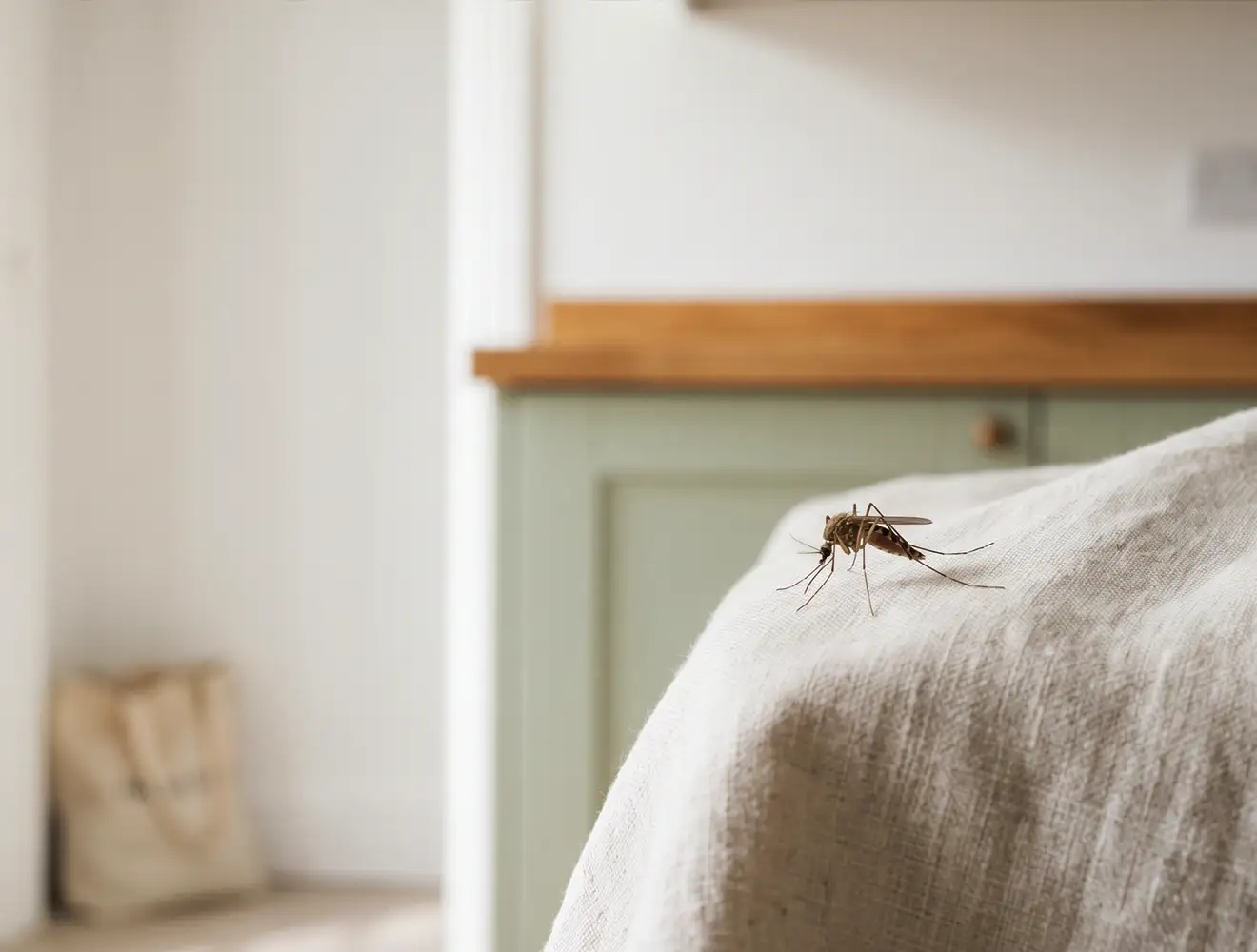
I am always that type sitting outside in the evening heat wearing long pants pulled into high socks, constantly reapplying an after-bite stick, and still waking up at night scratching my skin raw. Every year you will see me buying all the sprays and “after bite”-sticks possible including nets, citronella candles, and plug-in devices, but on every single trip, the mosquitoes always seem to find me anyway.
This past summer vacation, however, something was completely different. I still got bitten—quite a lot, actually—but the bites themselves didn’t swell up into large, angry bumps, and the unbearable itch was barely there. For the first time in as long as I can remember, mosquito bites were not something that disrupted my sleep or ruined my vacation.
So what had changed this year?
A few months before our trip, I had started taking a daily quercetin supplement as part of my morning routine, primarily for its well-known role in healthy aging and cellular support.
But sitting on vacation and realising I wasn’t constantly scratching my legs—or anywhere else—I started wondering: Could quercetin actually be the reason my mosquito bites aren’t itching nearly as much as usual?
When I got back home, I decided to look into the research to see if there was any real scientific explanation behind my experience and here is what I found out:
Quercetin as an antihistamine: What’s happening in the body?
To understand why my skin reacted so differently this year, we have to look at how our immune system responds to a bite or an environmental trigger.
When a mosquito bites you or when you react to an allergen like pollen, specialised immune cells in your body called mast cells immediately swing into action. Mast cells act like little security guards stationed throughout your tissues, particularly in your skin, gut, and respiratory system. When they detect an intruder—like the foreign proteins in mosquito saliva—they break open and release a chemical messenger called histamine.
Histamine causes local blood vessels to expand and become leaky so that defense cells can reach the site quickly. This influx of fluid and immune activity is what causes the classic redness, swelling, and that sharp, maddening itch. It is also worth noting that this reaction can vary a lot from person to person. While some people barely notice a mosquito bite and only get a tiny pink dot, others experience intense swelling, burning, and severe itching that lasts for days.
In short
It’s not actually the mosquito bite itself that causes all the trouble, but the flood of histamine your mast cells release in response to it.
Related: Quercetin and allergies – the science-backed review
A common side effect of standard antihistamines
When allergic reactions or bug bites strike, many people instinctively reach for standard over-the-counter antihistamines. While these medications can certainly provide quick relief, they often come with a familiar downside: fatigue and brain fog.
This happens because classic antihistamines readily cross the blood-brain barrier¹. In the central nervous system, histamine actually plays a vital role as a neurotransmitter that keeps us alert, awake, and focused. When synthetic medications block these histamine H1 receptors in the brain, drowsiness and reduced alertness are common side effects¹.
How quercetin calms the immune response
So how does a plant compound actually stop a mosquito bite from itching?
To put it simply, most standard creams and pills try to fix the problem after your skin is already swollen and inflamed. Quercetin works completely differently by acting ahead of time at the cellular level.
Think of your mast cells as tiny water balloons filled with histamine. Instead of trying to mop up the mess after the balloon pops, quercetin helps strengthen the balloon’s outer shell², making it much harder to burst when a mosquito bites.
Because your mast cells stay calm, your body simply doesn’t release that massive wave of histamine into your skin². And unlike standard antihistamines, quercetin does this locally in your skin tissues without crossing into the brain to cause fatigue or brain fog¹.
This ability to calm overactive mast cells is also why quercetin is so widely studied for histamine intolerance—a condition where the body builds up too much histamine and struggles to break it down, leading to ongoing skin redness, flushing, and irritation.
Looking back at my vacation, it all suddenly clicked: I wasn’t itch-free because mosquitoes had miraculously stopped biting me. I was still getting bitten—my body just wasn’t panicking every single time it happened.
In short
Quercetin doesn’t repel mosquitoes—it stops your body from overreacting to them.
What the scientific studies show
When I got home and dug into the research on how quercetin and histamine actually interact, I realized my vacation experience wasn’t just a coincidence.
The science backs it up completely:
When I got home and dug into the research on how quercetin and histamine interact, it suddenly made total sense why my vacation felt so different. The science showed that there wasn’t just one reason my skin stayed calm—quercetin was actually working on multiple levels at once:
- Quercetin tackles the reaction right at the source:
Studies show that quercetin directly blocks the internal triggers that make your mast cells burst open and release histamine². This explained why my body simply didn’t start its usual inflammatory fire. - Quercetin noticeably calms redness and swelling:
Clinical research demonstrates that quercetin significantly reduces skin redness and swelling when tissues are exposed to histamine³,⁴. This was why my bite marks stayed tiny, flat dots instead of turning into giant, angry welts. - Quercetin cuts off the itch signal to your brain:
Laboratory studies revealed that quercetin directly stops skin cells from sending “itch messages” along your nerve pathways⁵.
Looking back, I actually noticed every single one of these effects on my trip. Several times during the vacation, I’d look down, see the bites everywhere, and realize the urge to scratch just wasn’t there. My skin wasn’t nearly as red, the swelling stayed under control, and the maddening itch simply wasn’t being triggered. I wasn’t fighting the temptation to scratch—my body was just handling it smoothly, and I honestly felt a little proud.
Why bromelain completes the formula
In the supplement world, you will also frequently see quercetin bromelain histamine support formulas. Bromelain is a natural enzyme extracted from pineapples that breaks down complex proteins and helps your digestive tract absorb quercetin much more effectively.
This synergistic combo is the exact reason bromelain is included as a key supporting ingredient in our Purovitalis quercetin supplement. It ensures the active quercetin doesn’t just pass through your system, but actually gets absorbed into your bloodstream so it can do its job when you’re sitting outside on a warm summer evening and playing cards.
Related: Quercetin combined with zinc, vitamin C and bromelain
Quercetin for mosquito bites: Why my experience made scientific sense
At its core, a mosquito bite is simply a localized allergic reaction. When a mosquito feeds, it injects a tiny amount of saliva packed with foreign proteins. Your immune system spots these invaders right away, and your mast cells respond by flooding the surrounding skin with histamine.
Understanding this reaction is what makes using quercetin for bug bites so interesting.
Taking a daily supplement won’t act like a chemical repellent—it won’t create an invisible barrier that stops mosquitoes from landing on your arms while you’re sitting outside on your vacation without a single worry in the world. But because I had been taking it daily for a few months before our trip, my body was already prepared, prepared not to overreact.
My mast cells were far more stable and far less reactive. So when I was looking for a way to use quercetin for insect bites, the real magic wasn’t keeping the bugs away, as you would do with the citronella candles —but changing how my skin reacted after being bitten:
- The local inflammation stayed small, flat, and contained, rather than turning into huge, swollen bumps.
- The itching was doused to such a mild level that I barely noticed it throughout the day.
- Because I wasn’t scratching my skin open, I slept peacefully through the night and could actually enjoy my vacation properly.
So, if you ask me: does quercetin help with mosquito bites? My answer is a resounding yes. I will definitely make sure to supplement with quercetin before, during, and after my upcoming summer holidays. It honestly feels like I’ve finally figured it out, and I can’t wait for many more 100% worry-free summer vacations ahead.
A quick personal note
This is my own personal experience, which I share from the heart in the hope that it might help others dealing with the exact same summer issue. While these preliminary studies and scientific mechanisms explain why it worked so well for me, everyone’s body and immune system are unique, so individual results may vary.
References
- Farzam, K., et al. (2023). Antihistamines. StatPearls Publishing / NCBI Bookshelf.
- Mlcek, J., et al. (2016). Quercetin and Its Anti-Allergic Immune Response. Molecules, 21(5), 623.
- Maramaldi, G., et al. (2016). Soothing and anti-itch effect of quercetin phytosome in human subjects: a single-blind study. Clinical, Cosmetic and Investigational Dermatology, 9, 55–62.
- Yamada, S., et al. (2022). Effects of repeated oral intake of a quercetin-containing supplement on allergic reaction: a randomized, placebo-controlled, double-blind parallel-group study. European Review for Medical and Pharmacological Sciences, 26(12), 4301-4310.
- Lee, C. H., et al. (2021). Quercetin inhibits histamine-induced calcium influx in human keratinocyte via histamine H4 receptors. International Immunopharmacology, 96, 107620.



 English
 Dutch
Dutch German
 French
 Spanish
 Romanian
 Danish
 Italian