
Exercises for longevity
 Written byKarina Ahrenholt
 Reviewed bySamo Borko | Biochemist and Expert Formulator at Purovitalis
Exercise is one of the most important pillars of healthy, vital ageing. It helps you maintain fitness, muscle strength, mobility and balance, and is strongly associated with a longer lifespan.
You do not have to train intensively every day for that. It is the combination of strength training, cardio and daily movement that forms a strong basis. Yoga, stretching and balance exercises can complement that routine.

How much exercise makes a difference?
One large study followed more than 116,000 adults for around 30 years. People who did 150–300 minutes of vigorous or 300–600 minutes of moderate exercise a week had a lower risk of early death.¹
More exercise did not appear to be harmful, but the extra gain became smaller above these amounts. That mainly gives one practical message: exercising regularly counts for more than looking for the perfect workout.
Strength training: staying strong as you age
As you age, muscle mass and muscle strength gradually decline. Strength training helps you keep loading your muscles actively and makes daily activities such as climbing stairs, lifting and standing up easier.
Good basic exercises include:
- squats
- lunges
- deadlifts
- push-ups
- rowing movements
- exercises with resistance bands or weights
A well-known study in older adults showed that six months of strength training clearly improved muscle strength. The activity of hundreds of genes in muscle tissue also changed, including genes linked to mitochondrial function.²
Around and after the menopause too
Strength training is also important for women as they age. In a study of women before, during and after the menopause, an accessible programme using body weight, resistance bands and light weights led to more strength and balance after twelve weeks. The improvements were seen in all groups.³ Above all, it shows that strength training does not have to be heavy or complicated to make a difference.
Cardio: work on your fitness
Alongside strength, your cardiorespiratory fitness is important too. It says something about how well your heart, lungs and muscles work together during exertion.
A study of more than 122,000 adults found a clear relationship between better fitness and a lower risk of early death. This association remained visible in people with very high fitness as well.⁴
Cardio can take many forms:
- brisk walking
- cycling
- swimming
- jogging
- rowing
- tennis
- other sports that keep your heart rate raised for a longer time
And what about Zone 2?
Within longevity, Zone 2 training is often discussed. This is cardio at a moderate intensity that you can keep up for a longer time. A simple practical test: your breathing is clearly raised, but you can still hold a conversation.
Zone 2 can consist of brisk walking, gentle cycling, swimming or jogging, for example. Above all, it is an accessible way to build longer cardio sessions into your week.
Strength or cardio: which is better?
You do not have to choose. Strength training and cardio complement each other.
Strength training focuses mainly on muscle strength, muscle mass and physical resilience.
Cardio trains your heart, lungs and endurance.
For healthy ageing, the combination therefore makes more sense than optimising one form of training further and further. Add enough daily movement to that and you have the most important parts covered.
Do not forget mobility and balance
Being strong and having good fitness is valuable, but you also want to be able to keep moving smoothly and steadily.
Mobility and balance exercises therefore become more and more relevant as you get older. For example:
- stretching regularly
- yoga
- tai chi
- standing on one leg
- standing up and sitting down in a controlled way
- rotation and mobility exercises for the hips and upper body
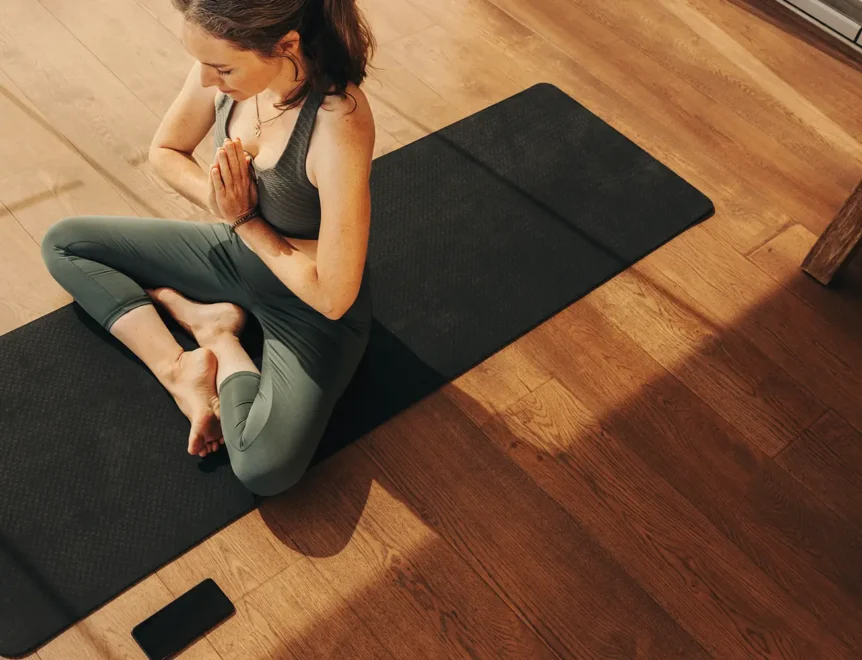
Yoga as an addition
Yoga combines mobility, flexibility, balance, strength and breathing. A 2024 scientific review describes research into physical function, stress, oxidative processes and various biological processes linked to ageing, among other things.⁵
You do not have to master complicated poses for that. A few simple exercises that you do regularly can already be a good addition to strength and cardio.
Traditional forms of movement count too
Not every longevity workout has to come from the gym. Tai chi, yoga and adapted martial arts often combine several qualities at once: balance, coordination, mobility, concentration and body control.
Especially when more intensive sports become less appealing or less feasible, such forms of movement can help you stay active.
In the end, the most important criterion is simple: choose a form of movement that suits your body and your life.
What does a good week look like?
There is no perfect schedule for longevity. A practical routine could consist of:
2–3 strength training sessions
Train the main muscle groups and build up the load gradually.
2–3 cardio sessions
Combine gentle to moderately intensive sessions with shorter, more intensive efforts if you like.
Move every day
Walk, cycle, take the stairs and avoid long periods in which you barely move.
Mobility and balance regularly
A few minutes a day can already be enough to include this part structurally.
You do not always need a gym for this.
It is never too late to start
Even if exercise has not had a fixed place in your life for a long time, you can still become clearly stronger and fitter later in life. Studies of strength training show this in older adults too.²
Read more about omega-3, vitamin D and exercise
So do not start with what is maximally possible according to a schedule, but with what you can keep up consistently. A daily walk can be the start. After that you can add strength training, cycling, swimming or other forms.
Within longevity, exercise is ultimately not about records. The goal is much more practical: staying strong, mobile and active for as long as possible.
References
- Lee DH, et al. Long-Term Leisure-Time Physical Activity Intensity and All-Cause and Cause-Specific Mortality: A Prospective Cohort of US Adults. Circulation, 2022. https://pubmed.ncbi.nlm.nih.gov/35876019
- Melov S, et al. Resistance Exercise Reverses Aging in Human Skeletal Muscle. PLOS ONE, 2007. https://pubmed.ncbi.nlm.nih.gov/17520024
- Svensen E, et al. A Novel Low-Impact Resistance Exercise Program Increases Strength and Balance in Females Irrespective of Menopause Status. Medicine & Science in Sports & Exercise, 2025. https://pubmed.ncbi.nlm.nih.gov/39480197
- Mandsager K, et al. Association of Cardiorespiratory Fitness With Long-term Mortality Among Adults Undergoing Exercise Treadmill Testing. JAMA Network Open, 2018. https://pubmed.ncbi.nlm.nih.gov/30646252
- Chen Q. Neurobiological and anti-aging benefits of yoga: A comprehensive review of recent advances in non-pharmacological therapy. Experimental Gerontology, 2024. https://pubmed.ncbi.nlm.nih.gov/39173784


 English
 Dutch
Dutch German
 French
 Spanish
 Romanian
 Danish
 Italian