
Berberine for weight loss: what does research show?
 Written byRein Ridder
 Reviewed bySamo Borko | Biochemist and Expert Formulator at Purovitalis
Berberine is often called “nature’s Ozempic” on social media, and many people try it in the hope of losing weight. Research into berberine and body weight does exist, but it shows a more nuanced picture than the posts suggest.
Does berberine help with weight loss, how does it relate to GLP-1 medicines such as Ozempic, and what should you keep in mind? In this article you can read what studies have measured so far, and where the evidence stops.
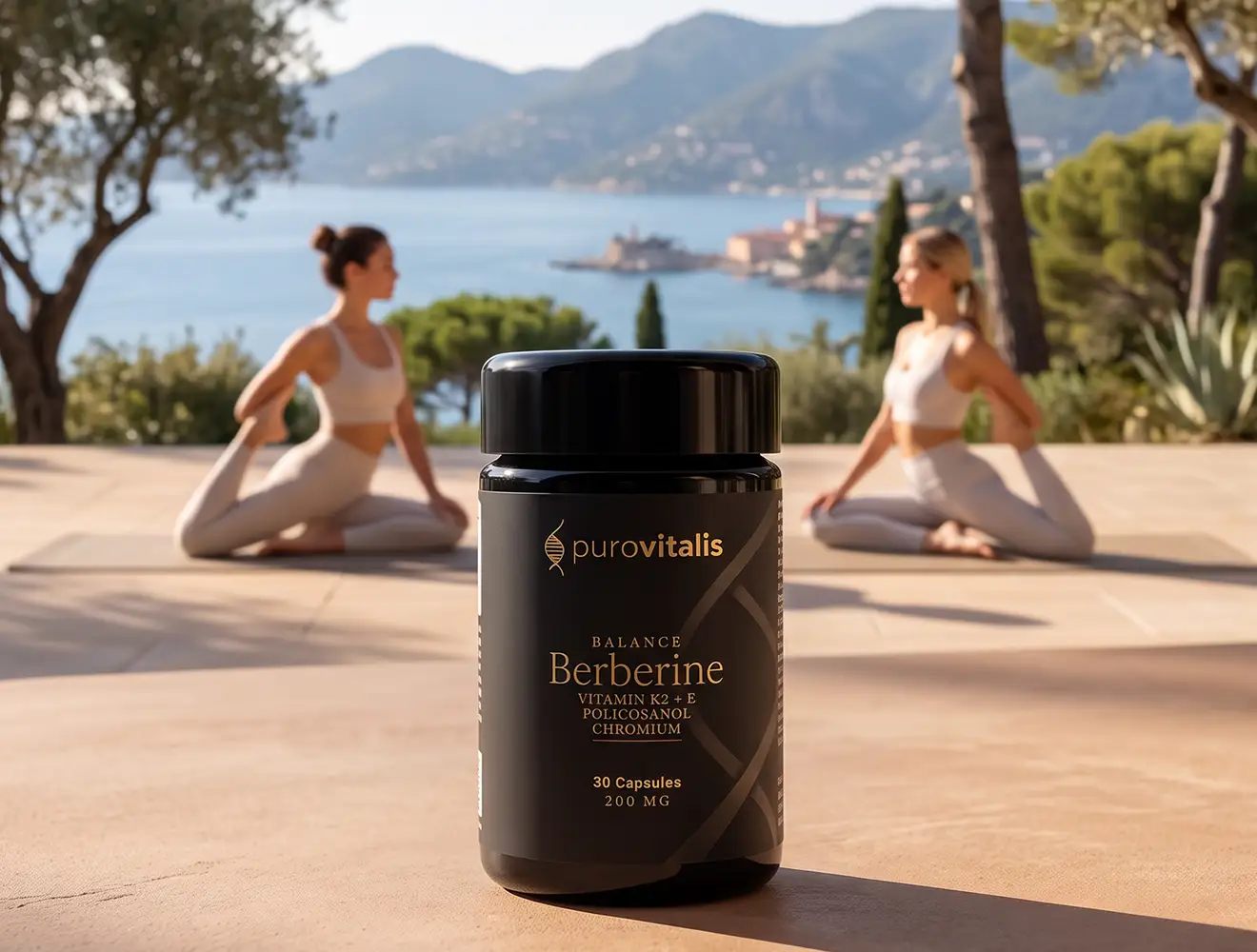
What is berberine?
Berberine is a yellow alkaloid found in plants such as barberry, goldenseal and Coptis chinensis. It has been used for centuries in traditional Chinese and Ayurvedic medicine. Today it is mainly studied for its relationship with blood sugar, insulin, cholesterol and body weight.
Why is berberine linked to weight loss?
Most of the interest comes from research into metabolism. Berberine is widely studied because of its influence on AMPK, an enzyme that acts as a kind of energy meter for cells and is involved in the processing of glucose and fats.¹ That ties in with the many studies into berberine, blood sugar and insulin sensitivity.
Researchers also look at the gut, where ordinary berberine, which is absorbed relatively poorly, is studied for its relationship with the gut microbiome. In rats and in cell research, berberine was found to stimulate the release of GLP-1, a gut hormone involved in blood sugar regulation and appetite.² Whether that also happens to a meaningful extent in humans is not known.
What does research show about berberine and weight loss?
Several meta-analyses have pooled randomised studies with berberine. A meta-analysis of twelve studies measured changes in body weight, BMI and waist circumference.³ A more recent meta-analysis of 23 randomised studies in adults found changes in the same three measures; the change in waist-to-hip ratio was not significant.⁴
The size of those changes is limited. In the most recent analysis, the average difference in body weight compared with the control groups was less than one kilogram.⁴ That is far from what is sometimes suggested online.
There are also important limitations. According to the US National Center for Complementary and Integrative Health, changes in weight were mainly seen with more than 1 gram a day for longer than eight weeks. Many studies had a high risk of bias, most were carried out in Asian countries, and most participants had a condition such as diabetes or fatty liver disease.⁵ It is therefore not clear what berberine means for people without such a condition.
That makes berberine interesting above all because of its broader relationship with glucose, fat and energy metabolism, and not as a weight-loss solution.
What about reviews and experiences?
Online you will find many personal experiences with berberine and weight loss, including before-and-after stories. They are understandable, but they cannot show what berberine itself does. People who start a supplement often change their diet, exercise or sleep at the same time, and weight naturally goes up and down. That is exactly why studies use a control group.
Berberine vs Ozempic: is berberine a natural Ozempic?
No. The comparison comes from the GLP-1 research mentioned above, but the two are very different.
Ozempic and Wegovy contain semaglutide, a prescription medicine that mimics the hormone GLP-1. These medicines were developed for diabetes and obesity, are used under medical supervision and have been studied in large clinical trials in people.
Berberine is a plant compound. Its relationship with GLP-1 comes mainly from animal and laboratory research, and as far as we know, no studies have compared berberine directly with GLP-1 medicines. Calling berberine “nature’s Ozempic” is therefore a marketing term, not a research finding.
Can you take berberine with GLP-1 medication or metformin?
Many people ask whether they can combine berberine with a GLP-1 medicine such as Ozempic, Wegovy or Mounjaro, or with metformin. As far as we know, berberine has not been studied together with GLP-1 medicines. For metformin there are a few small studies, mostly with goldenseal, a plant that contains berberine; in those, the amount of metformin in the blood was sometimes lower.⁶ What that means in practice is not clear.
What is known is that berberine can affect the breakdown of various medicines⁷ and has been shown to interact with cyclosporine, a medicine that suppresses the immune system.⁵ Berberine is also studied for its relationship with blood sugar, which is exactly what GLP-1 medicines and metformin act on. Whether berberine changes how strongly these medicines work has hardly been studied.
Do you use one of these medicines? Then discuss berberine with your doctor or pharmacist before you start, and never stop or change your medication on your own.
How much berberine is used in weight research?
There is no official daily reference intake for berberine. In weight research, changes were mainly seen with more than 1 gram a day for longer than eight weeks.⁵ Studies usually divide the daily amount over two or three moments around meals.
The form matters. Dihydroberberine is absorbed more easily than ordinary berberine and is converted back into berberine in the body. In a small pilot study with five men, 100 and 200 mg dihydroberberine gave higher berberine levels in the blood than 500 mg ordinary berberine.⁸ Research into body weight has so far mainly looked at ordinary berberine, and it is not known whether those findings apply to dihydroberberine. Follow the recommended daily dosage of the product you choose.
Read more about dihydroberberine
How long did the studies last?
Studies into weight ran for weeks to months, and the changes they report were measured over that whole period. There is no research into what happens within days.
Side effects and points to consider
The side effects of berberine reported most often are gastrointestinal, such as nausea, abdominal pain, a bloated feeling, diarrhoea or constipation.⁵
Berberine is not advised during pregnancy and breastfeeding, and it is not suitable for babies.⁵ Do you use medication or have a medical condition? Then discuss berberine with your doctor or pharmacist first.
Berberine and weight loss in brief
Berberine is studied above all for its relationship with glucose, fat and energy metabolism. Meta-analyses measured small average changes in body weight, BMI and waist circumference, mainly in people with a metabolic condition and in studies of varying quality.
Berberine is not a natural Ozempic. Weight is above all a matter of what you eat, how you move and how you sleep, over months and years. Research into berberine can be interesting within that picture, but it does not replace those basics.
References
- Sun A, et al. Molecular mechanisms, targets and clinical potential of berberine in regulating metabolism: a review focussing on databases and molecular docking studies. Frontiers in Pharmacology, 2024. https://pubmed.ncbi.nlm.nih.gov/38957396
- Yu Y, et al. Modulation of glucagon-like peptide-1 release by berberine: in vivo and in vitro studies. Biochemical Pharmacology, 2010. https://pubmed.ncbi.nlm.nih.gov/19945441
- Asbaghi O, et al. The effect of berberine supplementation on obesity parameters, inflammation and liver function enzymes: A systematic review and meta-analysis of randomized controlled trials. Clinical Nutrition ESPEN, 2020. https://pubmed.ncbi.nlm.nih.gov/32690176
- Elahi Vahed I, et al. The effect of berberine on obesity indices: a systematic review and meta-analysis. International Journal of Obesity, 2026. https://pubmed.ncbi.nlm.nih.gov/41310257
- National Center for Complementary and Integrative Health. Berberine and Weight Loss: What You Need To Know. https://www.nccih.nih.gov/health/berberine-and-weight-loss-what-you-need-to-know
- Nguyen JT, et al. The Pharmacokinetic Interaction Between Metformin and the Natural Product Goldenseal Is Metformin Dose-Dependent: A Three-Arm Crossover Study in Adults With Type 2 Diabetes. Clinical and Translational Science, 2025. https://pubmed.ncbi.nlm.nih.gov/39943692
- Guo Y, et al. Repeated administration of berberine inhibits cytochromes P450 in humans. European Journal of Clinical Pharmacology, 2012. https://pubmed.ncbi.nlm.nih.gov/21870106
- Moon JM, et al. Absorption Kinetics of Berberine and Dihydroberberine and Their Impact on Glycemia: A Randomized, Controlled, Crossover Pilot Trial. Nutrients, 2022. https://pubmed.ncbi.nlm.nih.gov/35010998



 English
 Dutch
 German
 French
 Spanish
 Romanian
 Danish
 Italian