
Why do we age? The 12 hallmarks of aging explained
 Written byRein Ridder
 Reviewed bySamo Borko | Biochemist and Expert Formulator at Purovitalis
Everyone ages, but why does the body gradually work less well? Scientists have studied this question for decades. In 2013, a group of researchers described nine “hallmarks of aging”: processes in our cells and body that change with age and help explain why we age. In 2023, they updated the list to twelve.
What are these hallmarks, and what do they mean in plain words? In this article you read why we age, what each of the 12 hallmarks means, and what research shows about influencing them.
Why do we age?
There is no single cause. Aging is a combination of small damage that builds up in your cells over many years, and repair systems that slowly work less well. At some point, the damage builds up faster than the body can repair it.
Researchers call the most important processes behind this the hallmarks of aging. A process only counts as a hallmark if it meets three conditions: it increases with age, speeding it up makes animals age faster, and treating it slows aging down in animals.
What are the 12 hallmarks of aging?
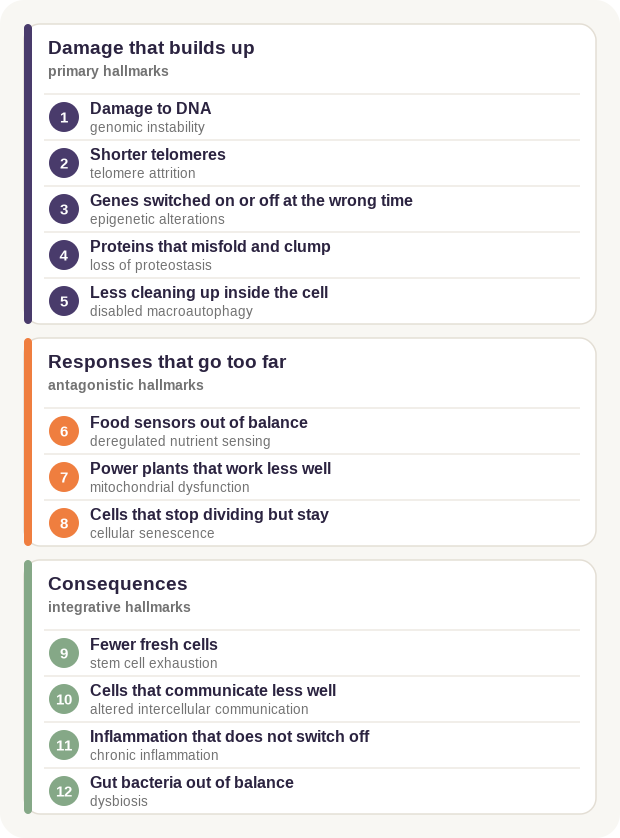
The 12 hallmarks fall into three groups. The first group causes damage. The second group consists of responses that are useful at first but cause problems when they go too far. The third group shows the consequences that you notice in tissues and organs. Researchers call these groups primary, antagonistic and integrative hallmarks.
The 12 hallmarks of aging explained
1. Damage to DNA (genomic instability)
Your DNA is the instruction manual of every cell. The DNA in each cell is damaged many thousands of times a day, for example by sunlight or by normal processes in the cell. Cells repair most of this damage, but not all of it. Over the years, small errors build up.
2. Shorter telomeres (telomere attrition)
Telomeres are protective caps at the ends of your chromosomes, a bit like the plastic tips on shoelaces. They get a little shorter each time a cell divides. When they become too short, the cell stops dividing.
3. Genes switched on or off at the wrong time (epigenetic alterations)
Every cell has the same DNA, but not every gene is active. Small chemical tags on the DNA and on the proteins it is wrapped around act like switches that decide which genes are on or off. With age, these switches drift, so cells read their instructions less accurately.
4. Proteins that misfold and clump (loss of proteostasis)
Proteins do most of the work in a cell, and they only work when they are folded into the right shape. With age, cells get worse at folding proteins correctly and at removing damaged ones, so faulty proteins can clump together.
5. Less cleaning up inside the cell (disabled macroautophagy)
Autophagy is the cell’s own recycling system: it breaks down worn-out parts and reuses the building blocks. With age, this recycling slows down, so waste builds up inside the cell.
6. Food sensors out of balance (deregulated nutrient sensing)
Cells have sensors that measure how much food and energy are available, such as the insulin/IGF-1 and mTOR signalling pathways and the enzymes AMPK and sirtuins. They decide whether a cell grows or repairs itself. With age, these sensors get out of balance.
Read more about intermittent fasting and healthy ageing
Read more about protein and aging
7. Power plants that work less well (mitochondrial dysfunction)
Mitochondria are the power plants of the cell: they turn food into energy. With age, they work less efficiently and release more reactive molecules that can damage the cell. The coenzyme NAD+ plays a role in this energy production.
8. Cells that stop dividing but stay (cellular senescence)
Senescent cells have stopped dividing but do not die, which is why they are sometimes called zombie cells. At first this is useful, because a damaged cell no longer copies itself. They also send out signals that cause inflammation. When more of these cells build up with age, this can harm the tissue around them.
9. Fewer fresh cells (stem cell exhaustion)
Stem cells are the body’s reserve cells: they replace worn-out cells in blood, skin, muscle and other tissues. With age, they work less well, and in some tissues there are fewer of them, so tissues repair themselves more slowly.
10. Cells that communicate less well (altered intercellular communication)
Cells constantly send each other signals, through hormones, nerves and the immune system. With age, these signals change, so the different parts of the body coordinate less well.
11. Inflammation that does not switch off (chronic inflammation)
Inflammation is a normal reaction that helps the body heal. With age, a low level of inflammation can remain present all the time, even without an infection or injury. Researchers call this inflammaging.
12. Gut bacteria out of balance (dysbiosis)
Your gut is home to trillions of bacteria that help digest food and train the immune system. With age, the mix of bacteria often changes, which researchers link to other hallmarks such as inflammation.
Find what fits you
Answer a few short questions and discover which supplements match your goals and daily routine.
Find your supplement9, 12 or 14 hallmarks of aging?
You may come across different numbers. The first list, from 2013, had nine hallmarks. In 2022, researchers at a meeting in Copenhagen proposed five additions: problems with autophagy, an unbalanced microbiome, chronic inflammation, splicing dysregulation and altered mechanical properties.
In 2023, the authors of the original list updated it to twelve. Three of those five are also on the 2023 list: autophagy, inflammation and the microbiome (dysbiosis). The 2023 paper treats the other two, errors in how cells cut and join the working copies (RNA) of their genes, and changes in how stiff cells and tissues are, as part of other hallmarks.
In 2025, several of the same researchers added two more in a new review: changes in the extracellular matrix, the material between cells that gives tissues their structure, and psychosocial isolation, meaning being socially isolated. That is why some sources now mention 14.
Which hallmarks of aging can you influence?
This is the question researchers are working on now. The three conditions for a hallmark were tested mainly in cells and animals. In people, studies mostly measure markers in the blood or muscle, not aging itself.
A few examples from human research:
- Eating less. In a two-year trial, healthy adults were asked to eat 25 percent fewer calories; on average they managed about 12 percent. Compared with a control group, they showed a slightly slower pace (2 to 3 percent) on one blood-based measure of biological aging. Two other measures showed no difference between the groups. This was an extra analysis done after the trial.
- Exercise. In a small 12-week study, both younger and older adults who did aerobic or strength training had more NAMPT, an enzyme that helps recycle NAD+, in their muscles. There was no group that did not exercise, and the study did not measure NAD+ itself.
- Sleep. Sleep is studied in relation to several hallmarks, such as inflammation. Most human studies are observational. In one short experiment in 29 older adults, a night of partial sleep loss changed markers of DNA damage and cell senescence in blood cells.
Hallmarks of aging in brief
Aging has no single cause. Researchers describe 12 hallmarks: damage that builds up, responses that go too far, and the consequences for tissues. The hallmarks are connected, so a change in one often affects others.
Most of what we know about slowing the hallmarks comes from research in cells and animals. In people, research is still at an early stage, which is why the hallmarks are one of the most active areas of longevity research.
Frequently asked questions
There is no single cause. Researchers describe aging as damage that slowly builds up in cells, combined with repair systems that work less well over time. The hallmarks of aging are the 12 processes they consider most important.
Twelve in the 2023 update by the researchers who wrote the original list; the first version, from 2013, had nine. A 2025 review by several of the same researchers added two more, so some sources mention 14.
Primary aging is the gradual change that happens to everyone over time. Secondary aging is caused by disease and by lifestyle and environment, such as smoking or too little exercise. In the hallmarks of aging, “primary” means something else: the group of hallmarks that cause damage.
In the hallmarks of aging, senescence means that a cell has stopped dividing for good but stays alive. Senescent cells, also called zombie cells, are one of the 12 hallmarks. The word senescence is also used for aging in general.
Most research on this has been done in cells and animals. In people, studies mostly measure markers in the blood or muscle, not aging itself. Diet, exercise and sleep are among the areas being studied.
References
- López-Otín C, et al. (2013). The hallmarks of aging. Cell, 153(6), 1194-1217. https://pubmed.ncbi.nlm.nih.gov/23746838/
- López-Otín C, et al. (2023). Hallmarks of aging: an expanding universe. Cell, 186(2), 243-278. https://pubmed.ncbi.nlm.nih.gov/36599349/
- Schmauck-Medina T, et al. (2022). New hallmarks of ageing: a 2022 Copenhagen ageing meeting summary. Aging, 14(16), 6829-6839. https://pubmed.ncbi.nlm.nih.gov/36040386/
- Waziry R, et al. (2023). Effect of long-term caloric restriction on DNA methylation measures of biological aging in healthy adults from the CALERIE trial. Nature Aging, 3(3), 248-257. https://pubmed.ncbi.nlm.nih.gov/37118425/
- Kroemer G, et al. (2025). From geroscience to precision geromedicine: understanding and managing aging. Cell, 188(8), 2043-2062. https://pubmed.ncbi.nlm.nih.gov/40250404/
- Carroll JE, et al. (2016). Partial sleep deprivation activates the DNA damage response (DDR) and the senescence-associated secretory phenotype (SASP) in aged adult humans. Brain, Behavior, and Immunity, 51, 223-229. https://pubmed.ncbi.nlm.nih.gov/26336034/
- de Guia RM, et al. (2019). Aerobic and resistance exercise training reverses age-dependent decline in NAD+ salvage capacity in human skeletal muscle. Physiological Reports, 7(12), e14139. https://pubmed.ncbi.nlm.nih.gov/31207144/
Add Purovitalis as a preferred source on Google Google then shows more of our articles in your search results.

 English
 Dutch
 German
 French
 Spanish
 Romanian
 Danish
 Italian