
Resveratrol foods: 5 natural sources and how much they contain
 Written byRein Ridder
 Reviewed bySamo Borko | Biochemist and Expert Formulator at Purovitalis
Which foods contain resveratrol? Resveratrol is found in grapes, mainly in the skin, and in red wine, peanuts, blueberries, cranberries, plums, pistachios and cocoa. The amounts are small and differ by variety, origin and how the food is processed.
Resveratrol is a plant compound, a polyphenol, that receives a lot of attention in research into healthy ageing. Which foods contain the most, how much is that, and can you get a meaningful amount from food? In this article you find a table with measured amounts and what research shows.
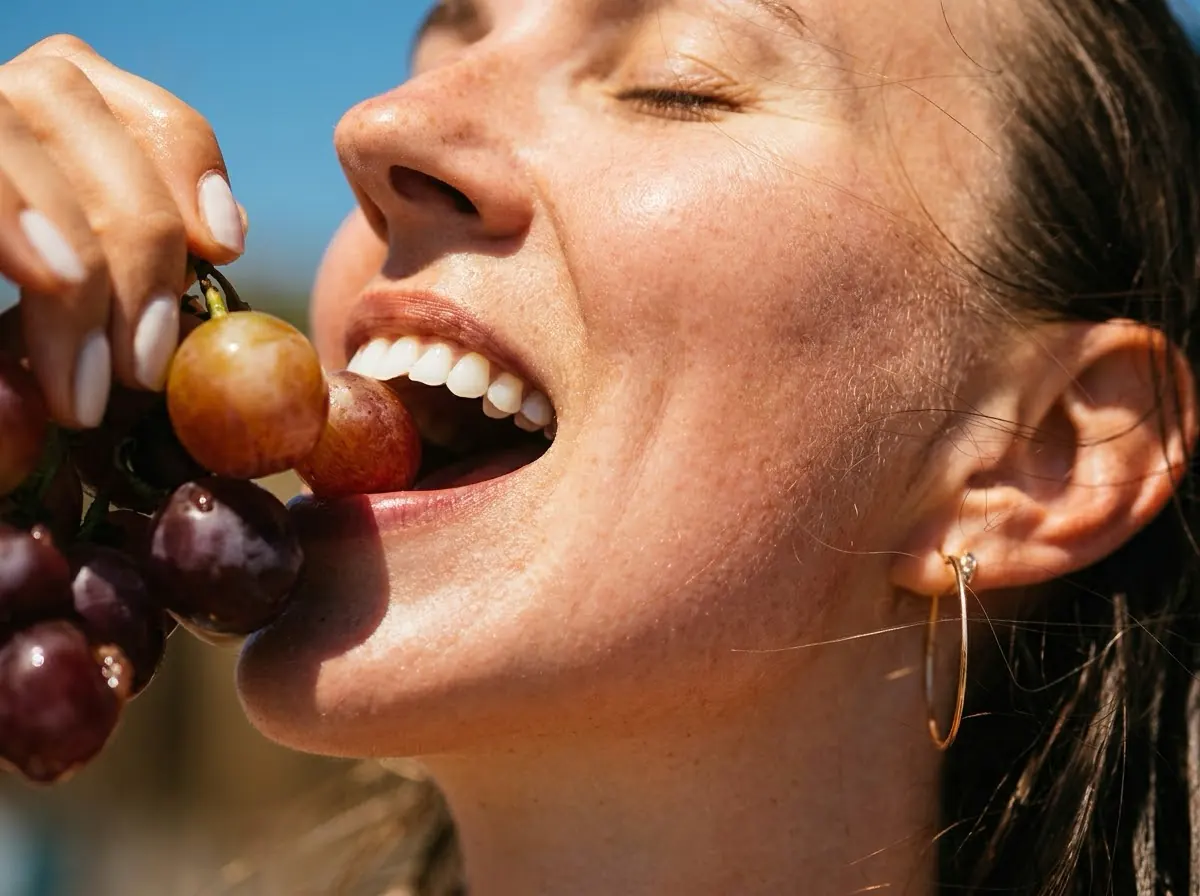
Foods high in resveratrol
Plants make resveratrol mainly in response to stress, such as fungal infection or UV light. That is why the amount in the same food can differ a lot between varieties, regions and harvests. The table shows amounts measured in food analyses, in micrograms per gram of food (one microgram is a thousandth of a milligram).
| Food | Resveratrol (µg per g) | Study |
|---|---|---|
| Boiled peanuts | 5.1 | Sobolev 1999 |
| Plums, skin only | 0.1–6.2 | Sebastià 2012 |
| Red wine (Italian) | 2.0–5.7 per ml | Wang 2002 |
| Cocoa powder | 1.85 | Hurst 2008 |
| Pistachios | 0.09–1.67 | Tokuşoğlu 2005 |
| Peanuts (Turkish varieties) | 0.03–1.92 | Tokuşoğlu 2005 |
| Grape juice (Concord) | 0.36 | Wang 2002 |
| Dark chocolate | 0.35 | Hurst 2008 |
| Peanut butter | 0.32 | Sobolev 1999 |
| Cranberry juice | 0.24 | Wang 2002 |
| Milk chocolate | 0.10 | Hurst 2008 |
| Roasted peanuts | 0.055 | Sobolev 1999 |
| Highbush blueberries (Michigan) | 0.03 | Lyons 2003 |
The studies used different methods: some measured only free resveratrol, others also its bound form (piceid). Use the values to compare foods, not as exact amounts.
1. Red grapes and resveratrol
In grapes, resveratrol sits mainly in the skin, and the grape variety plays a large role in how much of these compounds a grape contains. A North American analysis of dried berries reported about 6.5 micrograms per gram for grapes, similar to lingonberries; these values are for dried fruit and cannot be compared with the table. Concord grape juice contained about 0.36 micrograms per gram.
2. Blueberries
Not every blueberry sample contains measurable resveratrol. In one analysis, highbush blueberries from Michigan contained about 0.03 micrograms per gram, while highbush blueberries from British Columbia contained none that could be measured. That is less than a tenth of the amount reported for grapes. Baking for 18 minutes at 190 °C broke down 17 to 46 percent of it.
Besides resveratrol, blueberries contain anthocyanins, the pigments that give them their colour, which are studied separately.
Read more about anthocyanins in food
3. Resveratrol in peanuts
In an analysis of commercial peanut products, boiled peanuts contained the most resveratrol, about 5.1 micrograms per gram. Peanut butter contained about 0.32 and roasted peanuts about 0.055 micrograms per gram. In Turkish peanut varieties, the amount ranged from 0.03 to 1.92 micrograms per gram.
4. Cranberries
Cranberries also contain resveratrol. In one analysis, cranberry juice contained about 0.24 micrograms per gram, slightly less than grape juice. Both values include the bound form of resveratrol. Lingonberries, which belong to the same plant genus, contained the most resveratrol of all berries tested in a North American analysis of dried fruit.
5. Plums
A small Spanish analysis found resveratrol in the skin of plums, from 0.1 to 6.2 micrograms per gram of skin. European plum varieties contained more than Japanese varieties.
Other sources: cocoa and pistachios
Cocoa powder contained about 1.85 micrograms of resveratrol per gram, dark chocolate about 0.35 and milk chocolate about 0.10, in an analysis of 19 US products. The more non-fat cocoa solids a product contains, the more resveratrol. Pistachios from Turkey contained 0.09 to 1.67 micrograms per gram.
Is red wine a good source of resveratrol?
Red wine is a relatively rich source of resveratrol compared with grapes and peanuts. Red wine is fermented together with the grape skins, where resveratrol sits; white wine usually is not. In Italian red wines, researchers measured about 2.0 to 5.7 milligrams per litre, including the bound form.
In a Spanish study of more than 40,000 adults aged 35 to 64, wine supplied about 98 percent of resveratrol and its bound form in the diet. The median intake was about 100 micrograms a day, and about a third of the participants took in none at all. Drinking alcohol is not a sensible way to increase your resveratrol intake.
Can you get enough resveratrol from food?
The amounts in food are small. A 100-gram serving of boiled peanuts provides about half a milligram, and a glass of red wine of 150 ml up to about 0.9 milligrams. Human studies with resveratrol supplements use amounts in milligrams a day. In the EU, trans-resveratrol is authorised as a novel food in food supplements for adults, up to 150 mg a day.
In a study with six volunteers, at least 70 percent of a 25 mg dose was absorbed, but only traces of unchanged resveratrol were found in the blood, because the body converts it very quickly. In an Italian study of 783 adults aged 65 and over, resveratrol from the diet, measured as metabolites in 24-hour urine, was not linked to inflammation markers, cardiovascular disease or cancer, nor to mortality over nine years.
Find what fits you
Answer a few short questions and discover which supplements match your goals and daily routine.
Find your supplementResveratrol in food
Resveratrol is found in grapes, red wine, peanuts, pistachios, berries, plums and cocoa, mostly in small amounts measured in micrograms per gram. Boiled peanuts, plum skins, red wine and cocoa powder are among the richest sources that were measured.
Food gives you resveratrol together with fibre and other plant compounds. Human studies with resveratrol use amounts far higher than those in a normal diet.
Frequently asked questions
Resveratrol is made by plants, mainly in response to stress such as fungal infection or UV light. In food, it is found in the skin of grapes and in red wine, peanuts and pistachios, some berries, plums and cocoa. The amounts are small.
That differs by variety, climate and growing conditions, so there is no single answer. In grapes, resveratrol sits mainly in the skin, which is why red wine, made with the skins, contains more than white wine.
Some do. In one analysis, highbush blueberries from Michigan contained a small amount, while highbush blueberries from British Columbia contained none that could be measured. Baking broke down part of it.
Yes, in small amounts. In an analysis of commercial peanut products, boiled peanuts contained the most, peanut butter less, and roasted peanuts the least.
Resveratrol is a plant compound from the group of polyphenols. It receives a lot of attention in research into healthy ageing, mostly in cells and animals.
References
- Burns J, et al. (2002). Plant foods and herbal sources of resveratrol. Journal of Agricultural and Food Chemistry, 50(11), 3337-3340. https://pubmed.ncbi.nlm.nih.gov/12010007/
- Sobolev VS, Cole RJ. (1999). trans-resveratrol content in commercial peanuts and peanut products. Journal of Agricultural and Food Chemistry, 47(4), 1435-1439. https://pubmed.ncbi.nlm.nih.gov/10563995/
- Tokuşoğlu O, et al. (2005). Determination of the phytoalexin resveratrol (3,5,4′-trihydroxystilbene) in peanuts and pistachios by high-performance liquid chromatographic diode array (HPLC-DAD) and gas chromatography-mass spectrometry (GC-MS). Journal of Agricultural and Food Chemistry, 53(12), 5003-5009. https://pubmed.ncbi.nlm.nih.gov/15941348/
- Lyons MM, et al. (2003). Resveratrol in raw and baked blueberries and bilberries. Journal of Agricultural and Food Chemistry, 51(20), 5867-5870. https://pubmed.ncbi.nlm.nih.gov/13129286/
- Rimando AM, et al. (2004). Resveratrol, pterostilbene, and piceatannol in vaccinium berries. Journal of Agricultural and Food Chemistry, 52(15), 4713-4719. https://pubmed.ncbi.nlm.nih.gov/15264904/
- Wang Y, et al. (2002). An LC-MS method for analyzing total resveratrol in grape juice, cranberry juice, and in wine. Journal of Agricultural and Food Chemistry, 50(3), 431-435. https://pubmed.ncbi.nlm.nih.gov/11804508/
- Sebastià N, et al. (2012). A preliminary study of presence of resveratrol in skins and pulps of European and Japanese plum cultivars. Journal of the Science of Food and Agriculture, 92(15), 3091-3094. https://pubmed.ncbi.nlm.nih.gov/22763954/
- Hurst WJ, et al. (2008). Survey of the trans-resveratrol and trans-piceid content of cocoa-containing and chocolate products. Journal of Agricultural and Food Chemistry, 56(18), 8374-8378. https://pubmed.ncbi.nlm.nih.gov/18759443/
- Zamora-Ros R, et al. (2008). Concentrations of resveratrol and derivatives in foods and estimation of dietary intake in a Spanish population: European Prospective Investigation into Cancer and Nutrition (EPIC)-Spain cohort. British Journal of Nutrition, 100(1), 188-196. https://pubmed.ncbi.nlm.nih.gov/18096094/
- Walle T, et al. (2004). High absorption but very low bioavailability of oral resveratrol in humans. Drug Metabolism and Disposition, 32(12), 1377-1382. https://pubmed.ncbi.nlm.nih.gov/15333514/
- Semba RD, et al. (2014). Resveratrol levels and all-cause mortality in older community-dwelling adults. JAMA Internal Medicine, 174(7), 1077-1084. https://pubmed.ncbi.nlm.nih.gov/24819981/
- Mattivi F, et al. (2002). Wine, biodiversity, technology, and antioxidants. Annals of the New York Academy of Sciences, 957, 37-56. https://pubmed.ncbi.nlm.nih.gov/12074960/
- Wang W, et al. (2010). Distribution of resveratrol and stilbene synthase in young grape plants (Vitis vinifera L. cv. Cabernet Sauvignon) and the effect of UV-C on its accumulation. Plant Physiology and Biochemistry, 48(2-3), 142-152. https://pubmed.ncbi.nlm.nih.gov/20060310/
- Commission Implementing Regulation (EU) 2021/51 of 22 January 2021 authorising a change of the conditions of use of the novel food trans-resveratrol under Regulation (EU) 2015/2283 and amending Implementing Regulation (EU) 2017/2470. Official Journal of the European Union, L 23, p. 10. https://eur-lex.europa.eu/eli/reg_impl/2021/51/oj
Add Purovitalis as a preferred source on Google Google then shows more of our articles in your search results.



 English
 Dutch
 German
 French
 Spanish
 Romanian
 Danish
 Italian