

Ultra-processed foods have become a major part of modern diets—and researchers are increasingly linking them to conditions such as obesity, metabolic disorders, and even a shorter lifespan.
But what actually counts as ultra-processed food? And how do you spot it in everyday products? Most foods go through some level of processing, but the real difference lies in how far that process goes—and whether it preserves the food or transforms it into something entirely different.
In this blog, we break down what ultra-processed foods are, how they became so widespread, what the research says about their effects on health and longevity, and how you can realistically reduce your intake.
table of contents
What are ultra-processed foods
The term ultra-processed foods comes from the NOVA food classification system, developed by researchers at the University of São Paulo. The concept was formally introduced in 2009 to classify foods based on the degree of industrial processing rather than their nutrient content.
Unlike traditional nutrient-based classifications, NOVA focuses on how foods are produced and processed.
Ultra-processed foods are industrial formulations made mostly from substances extracted or refined from foods, with added emulsifiers, stabilizers, colorings, flavorings, and other additives. These products are designed to be highly palatable, shelf-stable, and convenient.
To understand what constitutes ultra-processed food, consider two simple approaches:
- Ingredient check:
Foods containing ingredients such as hydrogenated oils, artificial flavors, emulsifiers, modified starches, or other additives are often ultra-processed. A useful rule of thumb is that the ingredient list often contains substances you would not normally find in your own kitchen. - Practical assessment:
Could you realistically make the food at home from basic ingredients? If not, it is likely ultra-processed.
In short
Ultra-processed foods are industrial products made from food-derived ingredients combined with additives and designed to be shelf-stable, convenient, and highly palatable.
History behind ultra-processed food
It is difficult to pinpoint exactly when ultra-processed foods first appeared on the market. As we already know, the term itself was introduced in 2009 but foods that fit this category had already existed for many decades before the concept was formally defined.
Many researchers trace the roots of ultra-processed foods to the early industrialization of food production. In the early 20th century, the food industry began developing products that could last longer and be transported and stored more easily.
During World War II, technologies for producing shelf-stable military rations were further developed. These innovations helped accelerate the production of industrial, long-lasting foods.
After the war, many of these technologies were adapted for civilian markets. This period marked a major expansion of packaged and highly processed food products that later came to be classified as ultra-processed foods.
Over time, urbanization, busy lifestyles, and the growing demand for convenient foods contributed to the rapid expansion of ultra-processed foods in many countries, reinforced by the fact that these products are often more affordable than organically grown whole foods.
The research behind ultra-processed foods
The interest in understanding what happens when consuming ultra-processed foods has grown quickly in nutrition research over the past decade. Instead of focusing only on nutrients like fat, sugar, or salt, scientists are increasingly examining how the level of processing itself may influence health.
This growing interest has also reached the public through books and media. For example, How not to eat ultra-processed by Nichola Ludlam-Raine offers a practical approach to reducing intake, including a structured 4-week plan and simple dietary changes.
Ultra-processed people by Dr. Chris van Tulleken explores how these foods are produced, marketed, and consumed, highlighting how modern food environments shape our eating habits. The topic has also been explored in documentaries such as the BBC’s Irresistible: Why we can’t stop eating, which looks at why ultra-processed foods are designed to be highly appealing.
Recent research supports this broader perspective. A study published in 2026 by Gearhardt and colleagues draws parallels between the tobacco industry and the ultra-processed food industry, suggesting that many products are engineered to encourage repeated consumption.
Together, this reflects a shift in how we think about food—moving beyond nutrients alone and considering how it is designed and processed.
Processed vs ultra-processed
One common source of confusion is the difference between processed and ultra-processed foods. Not all processing is harmful. In fact, many traditional methods can help preserve nutrients and improve food safety.
For example:
- Freezing vegetables helps retain vitamins
- Fermenting foods may support gut health
- Pasteurization reduces the risk of foodborne illness
These are all forms of processing—but they don’t make a food unhealthy by default.
The distinction in the processed vs ultra-processed foods discussion is often explained using the NOVA classification system, developed by Monteiro and colleagues in 2019, which groups foods based on the degree of processing.
| Category | Examples | Characteristics |
|---|---|---|
| Minimally processed | Fresh fruit, vegetables, eggs | Natural foods with little to no alteration |
| Processed foods | Canned beans, cheese, bread | Simple processing methods, few added ingredients |
| Ultra-processed foods | Soft drinks, packaged snacks, instant noodles | Industrial formulations with multiple additives |
The difference
Processed foods are altered versions of whole ingredients and remain recognisable in structure and composition. Ultra-processed foods are industrial formulations made from refined components and additives, often far removed from their original form and designed to optimise taste, texture, and shelf life.
Ultra-processed foods impact on longevity
Research on processed foods and longevity is increasingly consistent: higher intake of ultra-processed food is linked to greater impact on aging and long-term health.
A study published in Age and Ageing found that higher consumption of ultra-processed food is associated with accelerated biological aging. For every 10% increase in energy intake from ultra-processed food, individuals showed signs of being biologically older—independent of overall diet quality.
This may help explain findings related to the ultra-processed foods impact on mortality. A large cohort study reported that higher intake of ultra-processed food is linked to an increased risk of all-cause mortality, suggesting a connection between dietary patterns and lifespan.
When discussing processed foods and aging, the distinction becomes key. Basic processing can support safety and preservation, but ultra-processed food appears to influence mechanisms such as inflammation, metabolic health, and cellular aging—all factors closely linked to longevity.
Read also: How mitophagy supports cellular health and aging.
Ultra-processed foods examples
Ultra-processed foods are widespread in modern diets and are often found in packaged snacks, ready meals, and fast foods. They are, as mentioned, usually high in sugar, salt, refined fats, and additives, making them hyper-palatable and easy to overconsume. Many of these foods are designed for convenience, long shelf life, and strong flavor, but they often lack essential nutrients.
Some commonly consumed ultra-processed foods include:
- Sugary breakfast cereals
- Packaged chips and snacks
- Instant noodles and flavored pasta
- Frozen ready meals
- Soft drinks and energy drinks
- Processed meats such as sausages and deli meats
- Fast food items like burgers, fries, and pizza
Many people wonder about everyday foods and whether they fall into the ultra-processed category. For instance, packaged pretzels often contain added oils and preservatives, which makes them a great example of ultra-processed foods. Cheese can be confusing: traditional varieties are usually just processed, but processed slices and spreads often count as ultra-processed. Plain dried pasta is generally not ultra-processed, but instant or flavored pasta products usually are.
How to spot ultra-processed foods
Many ultra-processed foods hide in products that seem healthy. Use food-scanner apps that scan barcodes or ingredient lists to quickly identify hidden ultra-processed ingredients and make more informed choices.
The diseases that ultra-processed foods may contribute to
A growing body of research links high intake of ultra-processed food to an increased risk of several chronic diseases.
Large cohort studies, including the French NutriNet-Santé study with more than 100,000 participants, show that higher consumption of ultra-processed food is associated with weight gain and metabolic disorders.
Higher intake has also been linked to type 2 diabetes. A large meta-analysis confirmed that people consuming more ultra-processed food have a higher risk of developing diabetes across different populations.
Mental health and cognitive health are now part of the discussion as well. A 2024 umbrella review in The BMJ, covering data from millions of participants, found consistent associations between ultra-processed food intake and depression, anxiety, and cognitive decline.
Scientists studying processed foods and aging propose several mechanisms that may explain these links:
- High energy density promoting weight gain
- Additives that may influence gut microbiota
- Increased intake of sugar, salt, and refined fats
- Lower intake of protective nutrients and fiber
While most findings are observational, the overall pattern is consistent: higher intake of ultra-processed food is associated with increased risk of chronic disease and reduced long-term health.
How to break free from ultra-processed foods
Reducing reliance on ultra-processed foods does not have to be strict or overwhelming. Small, consistent changes can make a meaningful difference over time.
Many nutrition experts recommend gradually shifting toward whole or minimally processed foods rather than trying to eliminate everything at once.
Some simple alternatives include:
- Fresh fruit instead of sugary snacks
- Whole grains instead of refined cereals
- Home-cooked meals instead of ready-made dishes
Building awareness is often the first step. Learning to read ingredient lists and recognize common additives can make it easier to spot ultra-processed foods.
Modern technology can also support this process. Smartphone apps that scan barcodes can help identify ultra-processed products and uncover hidden ingredients, making everyday food choices simpler.
Ultimately, the goal is not perfection, but balance—choosing foods that nourish the body while reducing reliance on products designed primarily for convenience and overconsumption. This growing evidence shows why the relationship between processed foods and longevity is becoming an important focus in modern nutrition research.
Supporting your body in a complex food environment
In a modern food environment, it is not always easy to know exactly what we are putting into our bodies. Even with the best intentions, many foods contain hidden additives, pesticide residues, and industrial ingredients that go far beyond what we would traditionally use in our own kitchens. This applies not only to ultra-processed foods, but also to conventionally produced ingredients where quality can vary.
Supporting the body is therefore not just about avoiding certain foods, but also about creating the best possible conditions for your cells to function and maintain resilience. This is where targeted supplementation can play a role—helping to support cellular health, energy metabolism, and the body’s natural defense systems.
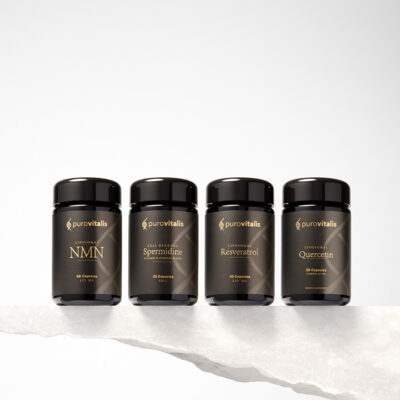
At Purovitalis, the focus is on purity, transparency, and scientifically grounded ingredients. Supplements such as NMN, Resveratrol, Spermidine, and Quercetin are selected for their role in supporting healthy aging and cellular function. Each product is carefully tested, with full certificates of analysis available, so you know exactly what you are taking.
If you are looking to support your body alongside a balanced diet, you can explore the full range here:
https://purovitalis.com/shop/
And learn more about product quality and testing here:
https://purovitalis.com/certificates-of-analyses/
References
- Monteiro CA, Cannon G, Levy RB, Moubarac JC, Louzada MLC, Rauber F, et al. Ultra-processed foods: what they are and how to identify them. Public Health Nutr. 2019;22(5):936–41.
- Gearhardt AN, DiFeliceantonio AG, et al. From tobacco to ultraprocessed food: how industry engineering fuels the epidemic of preventable disease. Milbank Q. 2026.
- Adjibade M, Julia C, Allès B, Touvier M, Lemogne C, Srour B, et al. Prospective association between ultra-processed food consumption and incident depressive symptoms. BMC Med. 2019;17:78.
- Srour B, Fezeu LK, Kesse-Guyot E, Allès B, Méjean C, Andrianasolo RM, et al. Ultra-processed food intake and risk of cardiovascular disease: prospective cohort study. BMJ. 2019;365:l1451.
- Pagliai G, Dinu M, Madarena MP, Bonaccio M, Iacoviello L, Sofi F. Consumption of ultra-processed foods and health status: a systematic review and meta-analysis. Br J Nutr. 2021;125(3):308–18.
- Lane MM, Davis JA, Beattie S, Gómez-Donoso C, Loughman A, O’Neil A, et al. Ultra-processed food and chronic disease: a systematic review and meta-analysis. BMJ. 2024;384:e077310.
- Wang L, Martínez Steele E, Du M, Pomeranz JL, O’Connor LE, Herrick KA, et al. Trends in consumption of ultra-processed foods among US youths and adults. JAMA. 2021;326(6):519–30.
- Chen X, et al. Interactions between ultra-processed food consumption and gut microbiota in relation to health outcomes. J Funct Foods. 2024.
- Study on ultra-processed food intake and biological aging. Age Ageing. 2024;53(12):afae268.
- Rico-Campà A, Martínez-González MA, Alvarez-Alvarez I, et al. Association between consumption of ultra-processed foods and all cause mortality: SUN cohort study. BMJ. 2019;365:l1949.

Track 50+ health metrics with AI-powered accuracy. Start your free trial today and take control of your wellness journey!
premium supplements Liposomal Technology made in EU Third party lab tested
Experience life to its fullest because you deserve the best! Try Purovitalis supplements!
Share: