



We live in a world built for comfort. Food arrives at the door, movement is often optional, and discomfort is something most of us try to avoid. That is understandable. Still, the body was never designed for constant ease. It seems to do better when it is challenged, at least a little.
That is the idea behind hormesis. When the body is exposed to a mild, controlled stressor, it can adapt and become more resilient.
Exactly that is the reason why hormesis has become such an interesting topic in longevity. Recent reviews describe hormesis as a fundamental adaptive response to moderate stress, with growing relevance for cellular resilience, health promotion, and age-related disease prevention.
In this blog, we take a closer look at hormesis and why it may play a role in healthy aging.
table of contents
Understanding of hormesis
To explain what hormesis means, it almost helps to start with a fairytale. Think of Goldilocks and the three bears. One was too much, one was too little, and one was just right. Hormesis works in much the same way.
It is all about the point where a challenge is strong enough to push the body to adapt, but not so strong that it causes harm. Too much of that same challenge can push the body in the opposite direction. This is the core of hormesis theory and the best way to understand the hormesis dose response curve. In science, hormesis is usually described as a biphasic dose response, where low doses can stimulate a useful adaptive response and higher doses can cause harm.
That is why hormesis stress should never be confused with stress in general. Hormesis is not about chronic overload. It is not poor sleep, constant pressure, or pushing the body past its limits. It is a short, manageable signal that gives the body a reason to adapt.
If someone asks, what is hormesis in simple terms, the clearest answer is this: hormesis is the body’s ability to become more resilient after a small, controlled challenge.
What is hormesis in nature and how do we know it works?
One reason hormesis has become such a widely discussed idea is that the same pattern appears across many areas of biology. A small amount of a challenge can stimulate repair or adaptation. A high amount of that same challenge can damage cells, tissues, or systems. That is why the hormesis dose response curve sits at the center of hormesis theory.
You can see this logic in daily life. Exercise is one of the clearest examples of hormesis. Too little movement weakens the body over time. Too much training without enough recovery breaks it down. The value sits in the middle. Goldilocks again.
Hormesis in nature
Some of the clearest examples of hormesis are found in plants. Plants cannot step into the shade, move away from drought, or escape heat, UV light, salty conditions, or physical damage. They have to stay where they are and deal with what comes. That might sound like a weakness, but in many ways it is the opposite. Plants are incredibly good at responding to stress by changing their internal chemistry.
One of their smartest tools is the production of polyphenols. Research tells us that these compounds help protect the plant under abiotic stress conditions and are a good example of hormesis in practice.
A challenge appears, the plant senses it, and the response helps it protect itself more effectively. Rather than simply being damaged by the environment, the plant adapts to it.
Xenohormesis: can we benefit from plant stress signals?
This is where the idea becomes even more interesting. If plants respond to stress by producing protective compounds such as polyphenols, could those same compounds do something meaningful in us when we eat them?
That is the idea behind xenohormesis. It suggests that animals and humans may be able to sense and respond to stress-related molecules produced by plants.
In other words
Some of the same polyphenols that help protect the plant may, when consumed, act as signals that encourage our own cells to activate protective and maintenance pathways.
This helps explain why polyphenols are so often discussed in relation to hormesis and aging. Rather than acting only as passive antioxidants, many are now described as signaling molecules that may help the body respond, adapt, and maintain balance more effectively.
Related: Polyphenols and sarcopenia: a scientific review of muscle aging
One of the best-known examples is resveratrol. This naturally occurring polyphenol, found in grapes and several other plants, is often mentioned in discussions about xenohormesis. Resveratrol has been linked to pathways involved in cellular stress responses, inflammation, and metabolic health, which helps explain its lasting role in longevity research. A 2024 systematic review of human clinical trials reported promising findings across several areas of health.
Seen in this light, xenohormesis may help explain why resveratrol continues to attract so much interest. Its value lies not just in the fact that it is found in plants, but in the way it may interact with the body’s own adaptive and protective systems over time.
The value of hormesis in anti-aging
It is probably already clear why hormesis and aging are so closely linked. Aging is, in many ways, a slow decline in the body’s ability to respond, adapt, and recover. As the years pass, cells become less effective at dealing with oxidative stress, metabolic strain, inflammation, and accumulated damage. That is exactly where hormesis becomes so relevant. At its core, hormesis is about adaptation, and that is one of the very capacities the aging body gradually begins to lose.
Recent reviews suggest that hormetic signaling may help support mitochondrial function, cellular maintenance, oxidative stress defenses, and other adaptive systems tied to healthy aging.
Bottomline
Rather than acting as a direct anti-aging fix, hormesis seems to work by encouraging the body to keep its own repair and defense pathways more active over time.
That is what makes hormesis so compelling in the context of longevity. The point is not that small stressors stop aging, but that they may help the body stay more responsive, flexible, and better prepared as it grows older. This helps explain why practices such as exercise, time-restricted eating, cold exposure, and polyphenol-rich foods keep appearing in healthy aging discussions. They may look very different on the surface, but they all follow the same basic pattern: a brief challenge, an adaptive response, and recovery.
The mechanics of hormesis induction
At the cellular level, hormesis works through stress-response systems that help the body adapt rather than break down. Reviews on hormesis and health point, as mentioned, to pathways linked with oxidative stress responses, mitochondrial regulation, cellular defense, and broader adaptive signaling.
In simple terms, a mild challenge tells the cell that conditions may be getting harder. The cell responds by strengthening internal defense systems. That may include better antioxidant enzyme activity, shifts in energy metabolism, improved mitochondrial performance, and stronger repair responses.
How to trigger hormesis
The practical side of hormesis is simple. You want the body to sense that harder times may be coming, then respond by becoming better prepared. The aim is not punishment. The aim is adaptation.
Hormesis in exercise
If one practice deserves to be called the classic example of hormesis, it is exercise. A review on physiological hormesis in biogerontology describes moderate and repeated physical exercise as the paradigm for physiological hormesis.
That makes hormesis exercise one of the clearest real-life examples of how this concept works. Training places temporary strain on muscles, energy systems, and recovery capacity. The body then adapts by improving strength, metabolic function, and resilience.
THE RIGHT AMOUNT OF CHALLENGE
When you start to feel lactic acid building up in your muscles, you are likely in the right zone, but stop before you overload the body.
More about longevity and exercise here: Exercises for longevity
Time-restricted eating
Time-restricted eating is one of the strongest modern examples of hormesis, though it may also be one of the oldest. In hunter-gatherer societies, food was not constantly available, and periods without eating were likely a normal part of life.
Going for longer periods without food creates a mild metabolic challenge, pushing the body to shift fuel use and adapt to a period of lower energy availability.
A 2026 systematic review and network meta-analysis in BMJ Medicine included 41 randomized controlled trials with 2,287 participants. It found that time-restricted eating was linked with improvements in body weight, fat mass, waist circumference, systolic blood pressure, fasting glucose, fasting insulin, and triglycerides, with earlier eating windows often performing better than later ones.
That makes time-restricted eating a very natural fit in any blog about hormesis stress. It is a manageable signal that food is not constantly available, and that seems to help preserve metabolic flexibility over time.
Hormesis cold exposure
Hormesis cold exposure has become one of the most talked-about modern techniques. Cold acts as a short-term physiological stressor. It challenges thermoregulation, circulation, and metabolism all at once.
A 2025 review in Life Sciences described possible links between controlled cold exposure and reduced chronic inflammation, improved metabolic health, and stronger antioxidant defenses. The same review made it clear that long-term risks still need more study, especially in older adults and people with cardiovascular concerns.
That is a good example of hormesis in action. A little cold may be useful. More is not automatically better.
Related: Benefits of cold exposure therapy: Are they worth it?
Hormesis breathwork
Hormesis breathwork usually refers to breathing practices that create a mild physiological challenge through breath holds, altered breathing patterns, or short periods of intermittent hypoxia.
A 2023 meta-analysis in Scientific Reports found that breathwork interventions were associated with lower self-reported stress and some improvements in mental health outcomes compared with non-breathwork controls.
That makes breathwork a meaningful part of the hormesis conversation, especially when it is practiced in a controlled and measured way. It fits the broader idea of giving the body a manageable signal and letting it adapt.
Related: The health benefits of breathwork
Hormesis-triggering foods
Food can trigger hormesis too, especially when it comes to polyphenol-rich plant foods. Berries, grapes, olives, cocoa, herbs, and tea all fit naturally into this discussion because they contain plant compounds tied to stress responses and xenohormesis.
This is one reason resveratrol keeps returning in discussions about hormesis, hormesis and aging, and longevity nutrition. It sits right at the point where plant stress, polyphenols, and human adaptive signaling meet.
Related: Function and benefits of anthocyanins
How to add hormesis to your longevity routine safely
The most important rule is simple: dose matters. A hormetic challenge should be manageable, brief, and followed by recovery. Too little may not do much. Too much may tip into harm.
That is why it makes sense to start small. For one person, that may mean more consistent exercise. For another, it may mean a sensible overnight fasting window, a short period of cold exposure, or more polyphenol-rich foods. The goal is not to stack every hormesis technique into one routine. The goal is to build a pattern the body can actually adapt to.
It helps to keep one distinction clear: hormesis is not the same as overload. The body benefits from a challenge it can answer. It does not benefit from being pushed beyond its capacity again and again.
Seen in that light, hormesis turns a modern assumption upside down. Health is not always about removing every kind of stress. Sometimes it is about meeting the right amount of challenge at the right time.
References
- Nocella C, Cammisotto V, Pigozzi F, Cavarretta E, d’Amati G, Volpe M, Carnevale R. Hormesis and health: molecular mechanisms and the key role of polyphenols. 2025.
- Wen X, Wang Y, Li J, et al. Current advances and future trends of hormesis in disease. 2024.
- Sharma A, Shahzad B, Rehman A, et al. The Role of Polyphenols in Abiotic Stress Response: The Influence of Molecular Structure. Plants. 2021;10(1):118.
- Hooper PL, Hooper PL, Tytell M, Vígh L. Xenohormesis: health benefits from an eon of plant stress response evolution. Cell Stress and Chaperones. 2010.
- Brown VA, Patel KR, Viskaduraki M, et al. Resveratrol for the Management of Human Health: How Far Have We Come? A Systematic Review of Resveratrol Clinical Trials to Highlight Gaps and Opportunities. International Journal of Molecular Sciences. 2024;25(2):747.
- Rattan SIS. Physiological hormesis and hormetins in biogerontology. Translational Medicine of Aging. 2022.
- Chen Y-E, Tsai H-L, Tu Y-K, Chen L-W. Effects of timing and eating duration of time restricted eating on metabolic outcomes: systematic review and network meta-analysis. BMJ Medicine. 2026.
- Boulares A, Jdidi H, Douzi W. Cold and longevity: Can cold exposure counteract aging? Life Sciences. 2025.
- Fincham GW, Strauss C, Montero-Marin J, Cavanagh K. Effect of breathwork on stress and mental health: a meta-analysis of randomised-controlled trials. Scientific Reports. 2023.
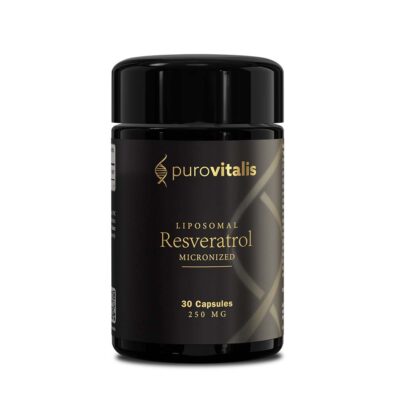
Liposomal Resveratrol maximum benefits improves sugar levels
Experience the best of resveratrol with Purovitalis liposomal formula. Try it out!
Share: