
Alpha-Ketoglutarate (AKG) and aging: What does the research show?
Exploring the potential of Alpha-Ketoglutarate (AKG) in improving human health and longevity, this molecule, central to the Krebs cycle, offers hope. Naturally found in the body, AKG not only supports essential biochemical processes but also shows potential to enhance healthspan and lifespan.
 Written byKarina Ahrenholt
 Reviewed bySamo Borko | Biochemist and Expert Formulator at Purovitalis
Alpha-ketoglutarate, often referred to as AKG, is receiving growing attention in aging research. It is a naturally occurring molecule in the body and plays a central role in cellular energy production.
In recent years, AKG has also gained attention for its potential role in healthy aging. This interest is based on a combination of preclinical findings, early human data, and ongoing clinical research.
But how much do we really know so far? Read along in this blog to explore what AKG does in the body, why researchers are studying it, and what the current science says about its possible role in aging and longevity.
table of contents

Introduction to Alpha-Ketoglutarate
AKG is an important part of the Krebs cycle, the process cells use to convert nutrients into energy. Beyond energy metabolism, AKG is involved in several biological processes linked to aging, including inflammation, cellular function, and gene regulation.
Read more here: What is Ca-AKG? Benefits, dosage and side effects
Why is AKG being studied in aging research?
Aging is shaped by many biological changes over time. These include shifts in energy production, increased cellular stress, changes in repair mechanisms, and altered metabolic signaling.
AKG has attracted attention because it appears to influence several of these processes. This does not mean it has been proven to slow aging in humans, but it does explain why it is being studied as a possible support for healthspan.
What have preclinical studies found?
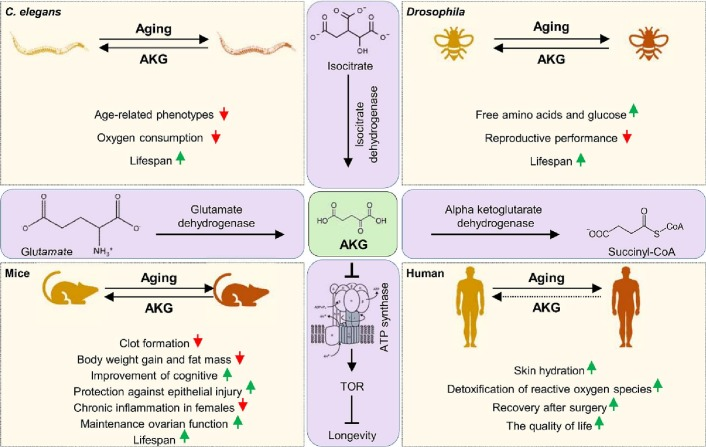
Much of the interest in AKG began with animal research. Studies in worms, flies, and mice have shown that AKG may influence both lifespan and health during aging.
In mice, AKG supplementation has been associated with longer lifespan and reduced frailty, suggesting that its effects may extend beyond basic metabolism. Other preclinical findings indicate that AKG may affect pathways such as mTOR and AMPK, both of which are widely studied in aging biology.
Related: What is AMPK and how can activator supplements enhance it?
These findings are important, but they remain preclinical. They help explain why AKG is being investigated further, though they cannot on their own confirm a benefit in humans.
This image illustrates where AKG fits into the body’s energy cycle and why it has become relevant in aging research across multiple species.
What do human studies show so far?
Human research on AKG is still limited, but a small number of early studies have produced findings worth noting.
Some human studies have examined calcium AKG in relation to biological age markers, including DNA methylation. These studies reported reductions in biological aging markers over relatively short periods.
These early findings are encouraging, but they should be interpreted with care. The studies were small, and some did not include placebo control. As a result, they are best seen as preliminary rather than conclusive.
At this stage, the human evidence is promising, but still developing.
The ABLE study: a key human trial on AKG
One of the most important studies currently investigating AKG is the ABLE study (Alpha-Ketoglutarate Supplementation and BiologicaL agE in middle-aged adults).
This is a randomized, double-blind, placebo-controlled clinical trial designed to test whether daily supplementation with calcium AKG can reduce biological age in humans.
The study includes around 120 healthy adults between the ages of 40 and 60, all of whom have a biological age higher than their chronological age.
Participants receive either 1 gram of sustained-release calcium AKG or a placebo for six months, followed by an additional three months of follow-up.
The main goal is to measure changes in biological age using DNA methylation. In addition, researchers are looking at a range of health markers, including inflammation, metabolic health, muscle strength, and cardiovascular function.
This makes the ABLE study especially important, as it moves AKG research from early signals into a well-controlled human setting.
Its results may help clarify whether AKG can meaningfully influence biological aging in humans.
Why ongoing clinical trials matter
In addition to the ABLE study, other clinical trials are also exploring the role of AKG in human health.
Another ongoing study, the STAMINA trial, includes calcium AKG as part of a multi-ingredient formulation. This trial is examining cardiovascular health, wellbeing, and biomarkers associated with aging.
Since AKG is only one component of that formula, the STAMINA study cannot isolate the effect of AKG alone. Even so, it shows that AKG is being included in broader human research on healthy aging.
AKG research extends beyond longevity
AKG has not only been studied in relation to aging. It has also been explored in other health areas, which helps provide a broader view of its biological relevance.
A recent review on osteoarthritis described how AKG may influence inflammation, oxidative stress, and tissue health. These are not the same as proven anti-aging effects, but they are relevant processes in age-related decline.
A 2025 preclinical study in a mouse model of Alzheimer’s disease found that AKG improved synaptic plasticity, an important feature of brain function. This finding adds a neurological angle to AKG research, though it remains early-stage evidence.
There are older human studies worth noting as well. In postmenopausal women with osteopenia, calcium AKG was associated with lower levels of a marker linked to bone breakdown. Bone health is an important part of aging well, which makes this study relevant even though it was not designed as a longevity trial.
Another older study in patients on hemodialysis found that calcium-alpha-ketoglutarate helped correct secondary hyperparathyroidism. This was not an aging study either, but it shows that AKG has been investigated in human health settings for many years.
What can we conclude at this stage?
Taken together, the current AKG research presents a promising but still incomplete picture.
The preclinical evidence is strong enough to justify continued interest. The biological mechanisms are plausible, and the early human findings provide enough support for further study. At the same time, the clinical evidence is not yet strong enough to make firm claims about AKG’s effect on human aging.
What is still needed are larger, well-controlled human trials that can clarify the size of the effect, identify who may benefit most, and determine how AKG performs over longer periods.
What comes next for AKG research?
AKG is now moving into a more important phase of research. The field is shifting from early signals and animal studies into more structured human trials.
That is the stage that will determine whether AKG can play a measurable role in healthy aging in humans.
For now, AKG stands out as a scientifically interesting compound with real potential, but the strongest conclusions will depend on the results of ongoing and future clinical studies. As research continues, the coming years will be important in determining whether this potential translates into real-world health benefits.
You might also want to read this blog: Alpha-Ketoglutarate study: The forgotten molecule that might help you age better
References
- Chin RM, Fu X, Pai MY, Vergnes L, Hwang H, Deng G, et al. The metabolite α-ketoglutarate extends lifespan by inhibiting ATP synthase and TOR. Nature. 2014;510(7505):397-401. doi:10.1038/nature13264.
- Hakimi S, Jafri SS, Naeini SH, Farahani M, Assadi-Porter FM, Fatemikia H. Alpha-ketoglutarate as a potent regulator for lifespan and healthspan: Evidences and perspectives. Exp Gerontol. 2023;176:112171. doi:10.1016/j.exger.2023.112171.
- Asadi Shahmirzadi A, Edgar D, Liao CY, Hsu YM, Lucanic M, et al. Alpha-ketoglutarate, an endogenous metabolite, extends lifespan and compresses morbidity in aging mice. Cell Metab. 2020;32(3):447-456.e6. doi:10.1016/j.cmet.2020.08.004.
- Ledwidge R, Kelly M, Girouard H, Hampf M, Santosa A, Wei C, et al. Rejuvant®, a potential life-extending compound formulation with alpha-ketoglutarate and vitamins, conferred an average 8 year reduction in biological aging, after an average of 7 months of use, in the TruAge DNA methylation test. Aging (Albany NY). 2021;13(22):24495-24520.
- Sandalova E, Goh J, Xu ZX, Tay A, Ng TP, Maier AB. Alpha-ketoglutarate supplementation and BiologicaL agE in middle-aged adults: study protocol for a randomized controlled trial. Aging Clin Exp Res. 2023;35:1989-1998. doi:10.1007/s40520-023-02415-1.
- ClinicalTrials.gov. Evaluation of the Efficacy of Calcium α-Ketoglutarate (AKG-Ca) in Improving Human Aging. Identifier: NCT07114536.
- ClinicalTrials.gov. Investigation of short and intermediate term effects of a supplement mix designed to target ageing mechanisms on vascular function in healthy middle-aged participants (STAMINA Study). Identifier: NCT06145087.
- Li J, Wang Y, Zhang X, et al. The research progress of α-ketoglutarate in osteoarthritis. Heliyon. 2025;11:e46117.
- Zhao Y, Zhang Y, Wang H, et al. Alpha-ketoglutarate ameliorates synaptic plasticity deficits in APP/PS1 mice model of Alzheimer’s disease. Aging Cell. 2025;24(8):e70136.
- Filip RS, Pierzynowski SG, Lindegard B, Wernerman J, Haratym-Maj A, Podgurniak M. Alpha-ketoglutarate decreases serum levels of C-terminal cross-linking telopeptide of type I collagen (CTX) in postmenopausal women with osteopenia: six-month study. Int J Vitam Nutr Res. 2007;77(2):89-97.
- doi:10.1024/0300-9831.77.2.89. Wiecek A, Chudek J, Kokot F. Long-term treatment with calcium-alpha-ketoglutarate corrects secondary hyperparathyroidism in hemodialysis patients. Miner Electrolyte Metab. 1996;22(1-3):196-199.




 English
 Dutch
Dutch German
 French
 Spanish
 Romanian
 Danish
 Italian