



Most people know L-Carnitine as a supplement linked to fat burning and exercise performance. But inside the body, its role is much more interesting. L-Carnitine helps transport fatty acids into the mitochondria, where they are used to produce energy.
This connection to cellular energy is one reason L-Carnitine has gained attention within longevity and healthy aging. Researchers are now looking beyond fitness and exploring how it may support energy levels, physical function, recovery, and mitochondrial health over time.
Read along in this blog and learn more about what L-Carnitine does, its benefits, possible side effects, and how it fits into a longevity-focused lifestyle.
table of contents
What is L-Carnitine & top sources
L-carnitine is a naturally occurring compound that plays an important role in how your body produces energy. Its primary function is to transport fatty acids into the mitochondria, where they can be converted into usable cellular energy. Since mitochondria are responsible for powering almost every process in the body, L-carnitine has gained increasing attention in longevity research and healthy aging discussions.
Although the body can produce L-carnitine from the amino acids lysine and methionine, diet still contributes significantly to overall levels. Animal-based foods contain the highest amounts, which is why people following plant-based diets often consume less L-carnitine through food.
The richest dietary sources include red meat, lamb, beef, fish, and dairy products. Smaller amounts are found in foods such as avocado and tempeh, though the levels are considerably lower.
Researchers have become interested in L-carnitine partly because mitochondrial function naturally declines with age. Lower mitochondrial efficiency can influence energy production, muscle function, cognitive performance, and physical resilience over time.
According to the landmark paper “The Hallmarks of Aging,” mitochondrial dysfunction is considered one of the central biological processes involved in aging itself.
This connection explains why nutrients involved in mitochondrial energy production, including L-carnitine, are often discussed within the field of longevity.
Related: Understand Mitophagy: Your body’s defense against aging
Acetyl L-carnitine & alpha lipoic acid
One of the most studied combinations in mitochondrial and brain aging research is acetyl L-carnitine together with alpha lipoic acid.
Acetyl L-carnitine (often shortened to ALCAR) is a form of L-carnitine that can cross the blood-brain barrier more efficiently than standard L-carnitine. Researchers have studied it for its possible effects on mental energy, cognitive performance, focus, and healthy brain aging.
Alpha lipoic acid works differently. It acts as an antioxidant and helps support mitochondrial function and cellular energy metabolism. Several animal studies have suggested that combining acetyl L-carnitine with alpha lipoic acid may improve mitochondrial efficiency and reduce markers associated with oxidative stress and aging.
Human studies are still limited, though the combination remains popular in longevity-focused supplementation routines because of its close connection to mitochondrial health.
L-Carnitine benefits
The main benefits of L-carnitine are closely linked to how the body produces and uses energy. Since mitochondria are involved in nearly every organ system, researchers continue investigating how L-carnitine may influence physical performance, recovery, metabolic health, and aging.
One of the reasons L-carnitine became popular in sports nutrition is its role in fat metabolism. By helping transport fatty acids into the mitochondria, the body can use fat more efficiently as an energy source during physical activity. This has led many people to associate L-carnitine primarily with fat burning.
The reality is more nuanced, read on.
Does L-carnitine burn fat?
L-carnitine is not a direct “fat burner” in the way many supplement advertisements suggest. Instead, it supports a biological process already taking place in the body.
A meta-analysis published in Obesity Reviews found that L-carnitine supplementation was associated with modest reductions in body weight, particularly in overweight adults. At the same time, the researchers emphasized that supplementation works best alongside proper nutrition and regular exercise.
In practice
L-carnitine may support energy metabolism and exercise capacity, though it is unlikely to create dramatic weight loss on its own.
For athletes and active individuals, some studies suggest L-carnitine may help reduce exercise-induced muscle damage and support recovery. This may partly explain why it remains a common ingredient in pre-workout and endurance supplements.
Related: Visceral fat and longevity
L-carnitine benefits for male health
L-carnitine has also been studied in relation to male reproductive health.
Sperm cells require large amounts of energy to maintain movement and function properly. Since L-carnitine is heavily involved in mitochondrial energy production, researchers have explored whether supplementation could support sperm quality.
A systematic review published in Andrology reported that carnitine supplementation may improve sperm motility in some men with fertility challenges. Researchers believe this may be related to improved mitochondrial energy production and reduced oxidative stress.
Although more research is still needed, these findings have made L-carnitine increasingly relevant in male fertility discussions.
L-Carnitine side effects and supplementation schedule
L-carnitine is generally considered well tolerated for most healthy adults when taken within commonly studied doses.
The most frequently reported side effects are mild digestive symptoms such as nausea, stomach discomfort, diarrhea, or cramping. Higher doses may occasionally cause a fish-like body odor due to the way L-carnitine is metabolized.
Many people specifically search for “L-carnitine 3000 side effects” because doses around 2–3 grams are common in sports supplementation. Research suggests these amounts are generally safe in healthy adults, though digestive side effects become more likely at higher intakes.
Another topic often discussed in longevity and cardiovascular research is TMAO (trimethylamine N-oxide). Certain gut bacteria can convert L-carnitine into compounds that later form TMAO in the liver. Elevated TMAO levels have been associated with cardiovascular risk in observational research.
At the same time, the relationship appears highly complex and influenced by overall diet, gut microbiome composition, metabolic health, and lifestyle. Current evidence does not support viewing L-carnitine itself as inherently harmful.
Supplementation schedule
L-carnitine is often taken earlier in the day or before exercise.
Some research suggests taking L-carnitine with carbohydrates may improve muscle uptake because insulin appears to support transport into cells. For this reason, many people choose to take L-carnitine with food rather than on an empty stomach.
Consistency may matter more than timing itself, especially when supplementation is used for general energy support or longevity-focused routines.
How much L-Carnitine do you really need?
The body naturally contains relatively large stores of L-carnitine, particularly in muscle tissue. Most healthy adults can produce sufficient amounts themselves, though intake from food still contributes significantly.
Typical supplemental doses range between 500 mg and 2,000 mg daily. In sports performance research, higher amounts are sometimes used temporarily.
In a 2021 systematic review and meta-analysis published in the Journal of Functional Morphology and Kinesiology, researchers found that around 2 g of L-carnitine per day appeared to be an effective dose for supporting physical performance in healthy adults, while higher doses did not clearly provide additional benefits.
The ideal intake depends on several factors, including:
- Diet
- Age
- Physical activity level
- Overall metabolic health
- Supplement goals
Someone focused on athletic performance may use higher doses around training periods, while people interested in healthy aging often prefer more moderate long-term intake.
More is not always better.
Supporting mitochondrial health involves much more than a single ingredient. Sleep, exercise, nutrition, stress management, and overall metabolic health all influence how efficiently mitochondria function.
L-Carnitine supplements
The popularity of L-carnitine supplements has grown significantly in both sports nutrition and longevity circles.
Different forms serve slightly different purposes. Standard L-carnitine is commonly used in exercise-focused products, while acetyl L-carnitine is more often associated with cognitive and neurological support.
For athletes, supplementation usually focuses on:
- Energy metabolism
- Endurance
- Recovery
- Fat utilization during exercise
Within longevity-focused routines, the conversation shifts more toward mitochondrial health, healthy aging, and cellular energy production over time.
Today, many people interested in longevity are moving away from aggressive “fat burning” approaches and instead focusing on ingredients that support how the body produces and uses energy throughout aging.
This is one reason compounds such as Calcium Alpha-Ketoglutarate (Ca-AKG) have received growing attention. Ca-AKG plays a role in mitochondrial energy metabolism and has been studied in relation to biological aging pathways and cellular health.
Rather than focusing purely on burning more calories, the broader goal is supporting sustainable energy production, physical function, and vitality over time.
L-Carnitine as an upgrade to Purovitalis Calcium AKG supplement
At Purovitalis, we focus on ingredients that support how the body functions over time — not quick fixes or short-term trends. We have added L-carnitine into our ca-AKG supplement as it fits naturally into this approach because of its connection to mitochondrial health, energy production, and physical function.
As we age, mitochondrial efficiency naturally changes. This can affect how much energy we feel, how well muscles perform, and how quickly we recover. Since L-carnitine helps transport fatty acids into the mitochondria, we see its value beyond fat burning. For us, it is about supporting cellular energy and long-term vitality.
This also connects to our broader Ca-AKG formula, which was developed to support the body’s natural energy systems and healthy aging pathways. We have also added Vitamin B12, which contributes to normal energy metabolism, nervous system function, and the reduction of tiredness and fatigue.
Read all about Vitamin B12 here:
Together, L-carnitine, Ca-AKG, and Vitamin B12 support the same goal: helping the body maintain energy, function, and vitality over time. Try our upgraded Ca-AKG formula here.
References
- López-Otín C, et al. The Hallmarks of Aging. Cell. 2013.
- Hagen TM, et al. Acetyl-L-carnitine and lipoic acid supplementation. PNAS. 2002.
- Pooyandjoo M, et al. The effect of L-carnitine on weight loss. Obesity Reviews. 2016.
- Broad EM, et al. Oral L-carnitine supplementation and exercise performance. International Journal of Sport Nutrition and Exercise Metabolism. 2005.
- Salas-Huetos A, et al. Effect of carnitines on sperm quality. Andrology. 2017.
- NIH Office of Dietary Supplements – Carnitine Fact Sheet.
- Koeth RA, et al. Intestinal microbiota metabolism of L-carnitine. Nature Medicine. 2013.
- Stephens FB, et al. Carnitine uptake in human muscle. Journal of Physiology. 2006.
- Vecchio M, Chiaramonte R, Testa G, Pavone V. Clinical Effects of L-Carnitine Supplementation on Physical Performance in Healthy Subjects, the Key to Success in Rehabilitation: A Systematic Review and Meta-Analysis from the Rehabilitation Point of View. Journal of Functional Morphology and Kinesiology. 2021;6(4):93.
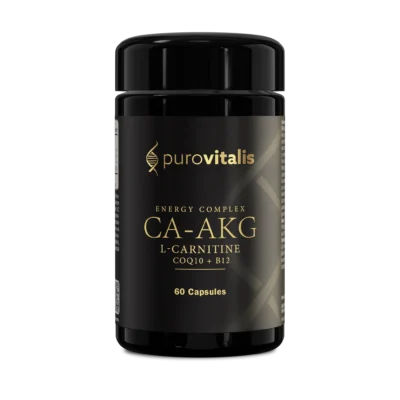
Calcium AKG Slow Release strengthen bones support longevity
Enhance physical performance and metabolic health with Purovitalis Calcium AKG. Try it out!

Track 50+ health metrics with AI-powered accuracy. Start your free trial today and take control of your wellness journey!
Share: