
As we age, changes in the skin become more visible. Fine lines deepen, skin tone may appear less even, and the skin often feels drier over time. While these changes are a natural part of aging, interest in methods that help reduce visible signs of skin aging remains high.
Each year, significant resources are invested in skincare products and treatments aimed at reducing wrinkles wrinkles and making the skin appear more youthful and supple.. Research shows that some approaches are more effective than others, which has increased attention on strategies that support the skin both externally and internally.
Resveratrol has attracted particular interest because it can be used both topically and orally. In a 2025 human clinical study published in Frontiers in Aging, researchers investigated whether resveratrol, used orally, topically, or in combination, could lead to measurable improvements in visible signs of skin aging in women over 40.
Read on to explore what the study found.
table of contents
About the study
The study was conducted as a human clinical trial with a randomized, double-blind, placebo-controlled design and followed a parallel group structure over a total period of eight weeks.
A total of 134 healthy women aged 40 years and older were enrolled. Of these, 122 completed the study and were included in the final analysis. The primary goal was to evaluate whether trans-resveratrol could lead to measurable improvements in visible signs of skin aging under controlled conditions.
Skin assessments were performed at baseline, at a midpoint visit after four weeks, and again at the end of the study after eight weeks, using standardized and objective skin analysis methods. While the main skin outcomes are reported after the full eight-week intervention, the four-week measurements provide insight into early changes and treatment dynamics over time.
Study design & groups
Participants were randomly assigned to one of four groups. Each woman remained in the same group throughout the entire study period, and neither the participants nor the researchers knew which treatment any individual received.
The four groups were:
| Group | Oral capsule | Face cream |
|---|---|---|
| Group 1 (P*/P) | Placebo | Placebo cream (no resveratrol) |
| Group 2 (A**/P) | Resveratrol (75 mg/day) | Placebo cream (no resveratrol) |
| Group 3 (P/A) | Placebo | Resveratrol cream (1.5%) |
| Group 4 (A/A) | Resveratrol (75 mg/day) | Resveratrol cream (1.5%) |
What did the researchers investigate?
The study examined visible and measurable signs of skin aging using objective, standardized measurement tools rather than subjective assessments. Skin parameters were recorded at baseline, after four weeks, and after eight weeks, allowing comparisons between the four groups (P/P, A/P, P/A, A/A).
This approach made it possible to evaluate both early responses and more established effects of oral and topical resveratrol over the study period.
The researchers assessed the following parameters:
- Wrinkle depth and wrinkle area
- Skin pigmentation
- Skin surface texture
- Sebum production (skin oil levels)
- Skin hydration
- Skin elasticity
- Pore appearance
- Safety and tolerability
Study results
After four and eight weeks, the researchers compared skin measurements across all four groups to identify differences between placebo (P/P), oral resveratrol (A/P), topical resveratrol (P/A), and the combined approach (A/A). The results highlight where measurable changes occurred early in the intervention and where clearer effects were observed after the full eight-week period.
Wrinkles
When looking at changes in wrinkle scores over the eight-week study period, the most consistent and pronounced improvements were observed in the group receiving both oral and topical resveratrol (A/A). This group showed a statistically significant reduction in wrinkle scores compared with the placebo group (P/P) after eight weeks.

Insight
The table shows mean wrinkle scores (± SD) at baseline, week 4, and week 8. The combined oral and topical resveratrol group (A/A) demonstrated the largest reduction in wrinkle score after eight weeks, corresponding to an 11.9% decrease from baseline, compared with smaller changes in the other groups.
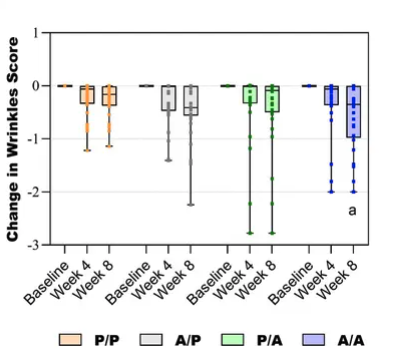
Likewise, the figure shows how wrinkle scores change over time across the four groups. Small and overlapping changes are seen after four weeks, while clearer differences emerge by week eight. The combined oral and topical resveratrol group (A/A) shows the most pronounced reduction in wrinkle scores compared with the placebo group (P/P).
Groups receiving either oral (A/P) or topical resveratrol (P/A) also show reductions, though to a lesser extent, while the placebo group shows minimal change.
Pigmentation
Changes in skin pigmentation were primarily observed in the groups using the resveratrol cream, namely (P/A) and (A/A). Pigmentation scores decreased over the eight-week period, indicating a more even skin tone.
Sebum production
Sebum levels increased in participants applying the resveratrol cream, with the largest increase seen in the combined treatment group. Since sebum plays an important role in maintaining the skin barrier, this change may be relevant in the context of age-related skin dryness.
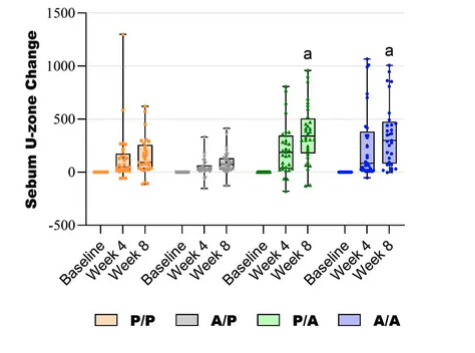
The figure illustrates changes in U-zone sebum levels over time across the four groups. An increase in sebum is observed primarily in the groups using the resveratrol cream, with the largest rise seen in the combined oral and topical group (A/A) by week eight. Smaller changes are seen in the oral-only group (A/P), while the placebo group shows minimal variation.
Sebum
Sebum is the skin’s natural oil, produced by the sebaceous glands. It helps protect the skin barrier, prevent moisture loss, and keep the skin soft and resilient.
Other skin parameters
No statistically significant changes were detected for skin hydration, elasticity, pore size, or skin temperature. The researchers note that deeper structural skin characteristics often require longer intervention periods to change measurably.
Safety and tolerability
The interventions were generally well tolerated throughout the study. No serious adverse events were reported. Mild skin irritation occurred in a small number of participants, mainly linked to topical application. No participants discontinued the study as a result of side effects.
Researchers’ interpretation
According to the authors, resveratrol may influence visible skin aging through mechanisms related to antioxidant activity and modulation of inflammatory pathways in the skin. The stronger effects observed with combined oral and topical use (A/A) support the view that skin aging is influenced by both internal and external factors.
The researchers also stress that the results relate specifically to visible signs of skin aging and do not address systemic aging or deeper biological aging markers.
Study limitations
Several limitations are acknowledged by the authors. The study duration was relatively short, and only women were included. The focus was limited to cosmetic and visual skin outcomes, and no molecular or histological analyses were performed. These factors should be taken into account when interpreting the results.
From research to practice
This 2025 clinical study shows that trans-resveratrol can lead to measurable improvements in visible signs of skin aging in women over 40. The most consistent effects were observed for wrinkle reduction, pigmentation, and skin oil balance, with the strongest results seen when resveratrol was used both as a supplement orally and topically as a cream. (A/A).
More about skincare here: Support your Skin, Hair & Joint health
From research to formulation
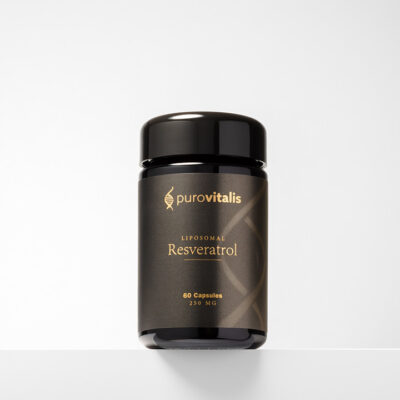
At Purovitalis, resveratrol is developed with a focus on purity, quality, and transparency. Human studies like this contribute to the growing evidence base around resveratrol and support its role in a science-based approach to healthy aging, including skin health.
For those who wish to support their skin from within, Purovitalis offers the Beauty Supplement Bundle, which combines resveratrol together with NAD+ and Rewind Liquid Collagen, formulated with nine supporting ingredients such as glycine and anthocyanins. The bundle is designed to complement a skin-focused routine by bringing together nutrients commonly associated with skin structure, maintenance, and overall skin support.
As with all Purovitalis products, the Beauty Supplement Bundle is developed with careful attention to ingredient quality, transparency, and formulation choices, making it suitable for those who prefer an evidence-informed approach to supplementation.
Related read Resveratrol and bone health: Study on postmenopausal women
References
- Rao A, Briskey D, Roche G, Tremblay A, Da Silva Pinto M, Tompkins TA. Trans-resveratrol reduces visible signs of skin ageing in healthy adult females over 40: an 8-week randomized placebo-controlled trial. Front Aging. 2025;6:1727244. doi:10.3389/fragi.2025.1727244