




What if your vitamin D levels in your 30s and 40s could influence your brain health decades later?
Researchers are increasingly interested in the connection between vitamin D and brain health, particularly whether vitamin D status earlier in life may influence cognitive aging decades later.
A new study published in 2026 found that adults with higher vitamin D levels in midlife had lower levels of tau protein in the brain 16 years later. ¹
Tau
One of the key proteins involved in Alzheimer’s disease and a marker of early brain changes associated with dementia.
In this article, we’ll explore the latest findings and what they may tell us about the relationship between vitamin D and dementia.
table of contents
What do we already know about vitamin D and dementia?
Before exploring the research, it is helpful to understand what dementia actually is.
According to the World Health Organization (WHO), dementia is a syndrome caused by diseases that affect the brain. It can interfere with everyday life and may affect:
- Memory
- Thinking and reasoning
- Orientation
- Learning ability
- Language and communication
- Judgment and decision-making
- Mood and behavior
WHO also mention in their factsheet that Alzheimer’s disease is the most common cause of dementia, accounting for an estimated 60–70% of cases worldwide.²
Dementia is not a normal part of ageing, although age is the strongest known risk factor. According to WHO, a person’s risk of dementia is influenced by a combination of genetic, lifestyle, environmental, and health-related factors.
Why vitamin D has become a focus of dementia research
This is where vitamin D becomes interesting. Several large human studies have found associations between low vitamin D levels, cognitive decline, and dementia.³⁻⁵ No single nutrient determines whether someone develops dementia, but these findings have raised an important question: could vitamin D status earlier in life influence brain health decades later?
Researchers have proposed several possible explanations. Vitamin D may help regulate inflammatory processes, reduce oxidative stress, support healthy blood vessels, and influence brain regions involved in memory and cognition.³⁻⁵
These findings do not prove cause and effect, but they provide biologically plausible reasons why the relationship between vitamin D deficiency and dementia continues to attract scientific attention.
How does alzheimer’s disease develop?
One reason researchers are interested in vitamin D is that changes in the brain associated with Alzheimer’s disease may begin years before symptoms become noticeable.⁶
Scientists have identified two proteins that play a central role in the disease:
- Amyloid-beta
- Tau
Amyloid plaques can begin accumulating in the brain decades before memory problems appear, while tau proteins can become abnormally modified and form tangles inside brain cells, disrupting communication between neurons.⁷
While both proteins are important, researchers increasingly believe that tau accumulation is more closely linked to cognitive decline and symptom progression.⁷
This is why studies investigating the potential vitamin d early dementia link are increasingly focusing on biological markers such as tau, rather than waiting for dementia diagnoses to occur years later.¹,⁷
Understanding these early brain changes may help researchers identify factors that influence cognitive health long before symptoms appear.
2026 study on vitamin D levels and dementia
To better understand whether vitamin D status earlier in life could influence these Alzheimer’s-related brain changes, researchers from the Framingham Heart Study followed hundreds of adults for more than 16 years.¹
The study included 793 dementia-free adults with an average age of 39 years when their vitamin D levels were measured.
Approximately 16 years later, participants underwent advanced PET brain scans to assess two important Alzheimer’s-related markers:
- Tau protein accumulation
- Amyloid protein accumulation
The results
Participants with higher vitamin D levels during midlife had significantly lower tau accumulation in the brain years later. The association was found both across the brain overall and in regions known to be especially vulnerable during the earliest stages of Alzheimer’s disease.
Researchers did not find a significant relationship between vitamin D levels and amyloid accumulation.
Important Note
This was an observational cohort study. Researchers measured vitamin D levels and followed participants for 16 years before assessing brain changes. The study found an association between vitamin D status and later tau accumulation, but it cannot on its own prove that vitamin D prevents dementia or causes the observed effects.
Why is this study important?
Many previous studies have focused on dementia diagnoses. This study took a different approach by examining biological changes in the brain before symptoms appear.
Tau is increasingly regarded as one of the strongest indicators of future cognitive decline. By finding an association between higher vitamin D levels and lower tau accumulation, the study strengthens the evidence supporting a possible vitamin d early dementia link.
Importantly, the findings do not show that vitamin D prevents dementia. Instead, they suggest that vitamin D status during midlife may be associated with some of the earliest biological changes linked to Alzheimer’s disease.
The authors concluded that low vitamin D in midlife may represent a potentially modifiable factor associated with preclinical Alzheimer’s-related brain changes.
Past studies on vitamin D and dementia
The Framingham study is one of the first to investigate whether vitamin D levels in midlife are associated with tau accumulation many years later. However, it is not the first study to suggest a connection between vitamin D and cognitive health.
Several large human studies have reported associations between vitamin D status and dementia risk.
Vitamin D supplementation and incident dementia
One of the most widely discussed studies in recent years was published in 2023 by researchers from the University of Calgary and the University of Exeter.³
This vitamin d dementia study from Canada analyzed data from 12,388 older adults who were dementia-free at the start of the study.
Researchers found that participants who reported taking vitamin D supplements had a significantly lower incidence of dementia during follow-up compared with non-users.
The association was particularly strong among women, supporting growing interest in women’s health vitamin d dementia research.
Importantly, here its also worth mentioning this study was observational and cannot prove that vitamin D supplementation directly reduced dementia risk. Nevertheless, it remains one of the largest studies investigating vitamin d supplementation and incident dementia to date.
Evidence from the UK Biobank
Another important study was published using data from the UK Biobank.⁴
Researchers followed more than 269,000 participants for an average of 13.6 years and examined the relationship between vitamin D status, vitamin D supplement use, and dementia risk.
The study found that individuals with vitamin D deficiency had a higher risk of developing dementia compared with those who maintained sufficient vitamin D levels.
The authors concluded that maintaining adequate vitamin D status may be relevant for long-term cognitive health, although further research is still needed to establish causality.
What do reviews and meta-analyses show?
A 2025 meta-analysis that combined data from multiple observational studies found that lower vitamin D levels were consistently associated with a higher risk of dementia and cognitive decline.⁵
Taken together, human studies continue to show a recurring link between low vitamin D status and poorer cognitive outcomes.
Researchers are careful to point out that these findings do not prove cause and effect. However, they help explain why studies such as the 2026 Framingham investigation are so important. Rather than focusing on dementia diagnoses alone, the Framingham researchers examined biological changes in the brain that may occur years before symptoms develop.
Vitamin D supplementation principles
Research into vitamin d supplementation and incident dementia is still ongoing, and no major health authority currently recommends vitamin D supplements specifically for dementia prevention.
However, vitamin D remains an essential nutrient for overall health. It contributes to:
- The normal function of the immune system
- The maintenance of normal bones and teeth
- Normal muscle function
- Normal calcium absorption and utilization
Vitamin D can be obtained through sunlight exposure, certain foods, and dietary supplements. However, maintaining adequate levels is not always straightforward.
People living in northern regions may produce little or no vitamin D from sunlight during parts of the year, particularly during autumn and winter. As a result, vitamin D deficiency is relatively common in many populations.
For individuals who are unable to maintain sufficient levels through sunlight exposure and diet alone, supplementation may be a practical option. Requirements vary depending on age, lifestyle, geographic location, skin pigmentation, and overall health status.
Testing your vitamin D levels
One challenge with vitamin D deficiency is that it often goes unnoticed. Symptoms can be subtle and may include fatigue, muscle weakness, low mood, or frequent infections. Many people experience no obvious symptoms at all.
If you’re unsure about your vitamin D status, testing can be a useful first step. A simple blood test can determine whether your levels are within the recommended range.
If a deficiency is identified, dietary changes, safe sun exposure, or supplementation may help restore healthy vitamin D levels.
Vitamin D in our supplements
Vitamin D has long been recognised for its role in bone health, immune function, and muscle function. More recently, researchers have begun exploring its potential role in healthy brain ageing, with a growing number of studies investigating links between vitamin D status, cognitive function, and dementia risk.
At Purovitalis, we focus on nutrients that support healthy ageing and vitality throughout life. Vitamin D is one of the most extensively studied nutrients in this area, with benefits that extend far beyond bone health.
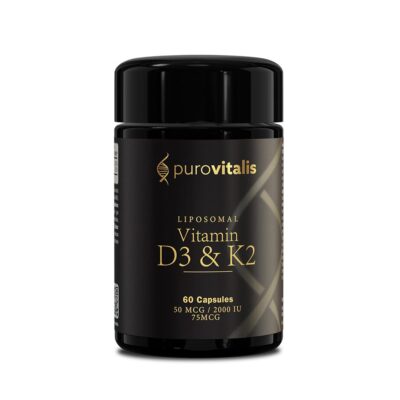
This is one reason why we recently added Vitamin K2 to our Liposomal Vitamin D3 supplement. Vitamin D helps the body absorb calcium, while Vitamin K2 helps direct that calcium to bones and teeth. Together, they are often combined in formulations designed to support long-term health.
Although research into vitamin D and brain health is still developing, maintaining adequate vitamin D levels remains a sensible part of a healthy ageing strategy alongside regular exercise, quality sleep, good nutrition, and cardiovascular health.
You can learn more about our Vitamin D3 + K2 supplement here: Liposomal Vitamin D3 & K2
Read more about Vitamin K2 here: Vitamin K2 for longevity: benefits, sources, and science-based tips
References
- Mulligan MD, Scott MR, Yang Q, Wang R, Ghosh S, Johnson KA, et al. Association of Circulating Vitamin D in Midlife With Increased Tau-PET Burden in Dementia-Free Adults. Neurol Clin Pract Open Access. 2026;2(2).
- World Health Organization. Dementia. Geneva: World Health Organization. Available from: https://www.who.int/news-room/fact-sheets/detail/dementia
- Ghahremani M, Smith EE, Nakhaei D, et al. Vitamin D supplementation and incident dementia: Effects of sex, APOE, and baseline cognitive status. Alzheimers Dement (Amst). 2023;15.
- Chen J, Campbell PT, Zhang X, et al. The associations of serum vitamin D status and vitamin D supplements use with all-cause dementia, Alzheimer’s disease and vascular dementia: A UK Biobank-based prospective cohort study. Am J Clin Nutr. 2024.
- Frontiers in Neurology. Vitamin D status and risk of dementia and cognitive decline: systematic review and meta-analysis. Front Neurol. 2025.
- Alzheimer’s Association. Alzheimer’s stages [Internet]. Chicago (IL): Alzheimer’s Association; [cited 2026 Jun]. Available from: https://www.alz.org/alzheimers-dementia/stages
- Jack CR Jr, Knopman DS, Jagust WJ, Petersen RC, Weiner MW, Aisen PS, et al. Tracking pathophysiological processes in Alzheimer’s disease: an updated hypothetical model of dynamic biomarkers. Lancet Neurol. 2013;12(2):207-216.
Vitamin D3 2000 IU liposomal delivery maximum bioavailability Immune Enhancer
Strengthen your immune system and promote bone health with Liposomal Vitamin D3! Try it out!

Track 50+ health metrics with AI-powered accuracy. Start your free trial today and take control of your wellness journey!
Share: